25 Easy Painting Ideas for Beginners That Actually Look Good
· Editorial Team · 13 min read
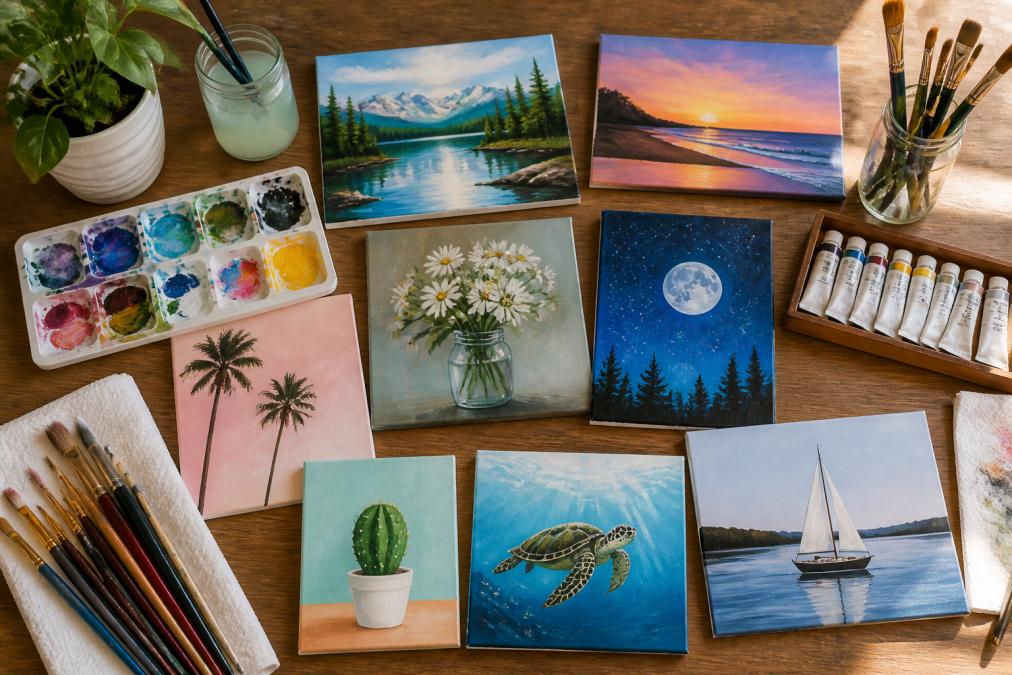
Table of Contents
- Why These Easy Painting Ideas Work for Absolute Beginners
- Essential Painting Supplies for Beginners: Start With Less Than You Think
- Acrylic Painting Techniques for Beginners: 5 Skills That Carry Every Project
- 15-Minute Easy Painting Ideas: Skies, Sunsets, and Simple Washes
- Weekend Easy Painting Ideas: Landscapes and Still Life That Teach Composition
- Easy Abstract Painting Ideas: Texture, Palette Knives, and Letting Go
- How Long Should a Beginner Painting Class Last? Structuring Your Session
- Use a Painting Workshop Lesson Plan Template to Teach Without Stress
- Frequently Asked Questions
Last Updated: September 6, 2026
The gap between wanting to paint and actually finishing a canvas usually comes down to one thing: choosing a project that matches your skill level. Easy painting ideas for beginners are the bridge across that gap, and they are far more abundant than most new artists realize. At PaintPrompt, we design class-ready painting projects for studios and hobbyists. This guide collects the best easy painting ideas for beginners, organized by how much time you have, so you can start creating today rather than staring at a blank white canvas.
Why These Easy Painting Ideas Work for Absolute Beginners
Most beginner guides fail because they assume you already understand composition, color mixing, and brush control. The ideas here assume you know none of that yet. Every project below relies on forgiving techniques where minor mistakes become part of the texture, not a reason to start over.
The secret is structured simplicity. A sunset with three horizontal bands of color teaches you the wash technique without demanding precise drawing. A single flower with layered petals builds confidence with blending. These projects are easy painting ideas for beginners because they limit your decisions: fewer colors, simpler shapes, and clear steps that lead somewhere recognizable.
Essential Painting Supplies for Beginners: Start With Less Than You Think
You do not need a wall of art supplies to finish your first painting. A basic kit includes acrylic paint in a starter color set, two or three synthetic brushes in flat and round shapes, one stretched canvas, and a palette for mixing. That is genuinely enough to complete every idea in this guide. But the retail art aisle is full of traps that waste money and discourage new painters. Here is how to build a kit that works without overspending.
Paint: The One Place Not to Skimp
Student-grade acrylic paint is the sweet spot for beginners (willkempartschool.com). Brands like Liquitex Basics and Arteza offer a 12-color set at major craft retailers like Michaels or Hobby Lobby. These paints have less pigment than professional lines, but they are far more forgiving and mix well. Avoid the cheapest craft-store house brands, which are often too thin and transparent, leading to frustration when colors do not cover. A 12-color set is better than an 8-color set because it includes a wider range of earth tones and secondary colors, which reduces the need for complex mixing early on. You do not need professional-grade paint like Golden or Winsor & Newton until you are selling work or have a specific need for their pigment load.
Brushes: Two Shapes, Not a Set of Twenty
A set of 20 brushes looks like a bargain, but most beginners end up using the same two or three. Buy individually instead. You need one flat brush (about 1/2 inch or 3/4 inch wide) for washes and backgrounds, and one round brush (about size 4 or 6) for details and lines. A filbert brush, which has a rounded tip, is a useful third addition for blending and soft edges. Synthetic bristles are the right choice for acrylics because they are durable, easy to clean, and cost $3 to $8 each. Avoid natural hair brushes, which are expensive and can be damaged by acrylic paint. The most common beginner mistake is buying brushes that are too small, which makes large areas tedious and encourages overworking the paint.
Canvas: Panels Beat Stretched Canvas for Practice
Stretched canvas is the classic choice, but canvas panels are a smarter buy for practice. A 9x12 inch canvas panel is often less expensive than a stretched canvas of the same size (jerrysartarama.com). Panels are rigid, do not bounce when you press on them, and store flat easily. They also take paint the same way, so the skill transfers directly. If you do buy stretched canvas, look for a medium-grain surface, not a fine-grain one. Fine-grain canvas is too smooth for acrylics and causes the paint to slide around. For absolute beginners, a pack of five 8x10 or 9x12 canvas panels is the best value. You will not feel guilty about experimenting, which is exactly the mindset you need.
Palette and Household Substitutes
A wet palette keeps acrylic paint workable for hours, but you can start with a disposable paper plate (liquitex.com). The problem with a dry palette is that acrylic dries quickly, and you will waste paint as it skins over. A simple hack is to place a damp paper towel under a sheet of parchment paper on a plate. This creates a DIY wet palette for pennies. A plastic takeout container with a lid works even better because you can seal it and keep paint fresh overnight. For cleanup, a cheap spray bottle filled with water lets you mist your palette to slow drying. You already have water cups and paper towels in your kitchen; dedicate one cup and a roll of paper towels to painting so you do not ruin your good kitchen towels with pigment.
The Dollar-Store Alternative
If your budget is extremely tight, a trip to Dollar Tree can cover most of your needs. They sell 8x10 canvas panels for $1.25 each, synthetic brush sets for $1.25, and plastic palettes. The paint they sell is not suitable for learning color mixing because it is too thin and low in pigment, so skip that. Instead, spend your money on a basic set of student-grade acrylics from a craft store. This hybrid approach keeps your total startup cost under $15 while giving you paint that actually behaves the way acrylic is supposed to. What matters is the paint itself: student-grade acrylic paint is affordable and forgiving, and it cleans up with soap and water. As you improve, you can invest in better brushes and more pigments, but the essential painting supplies for beginners are few and inexpensive.
Acrylic Painting Techniques for Beginners: 5 Skills That Carry Every Project
Acrylic paint is the ideal medium for beginners because it dries fast, layers well, and fixes mistakes easily. Master these five acrylic painting techniques for beginners and you can paint almost any simple subject.
- Wash technique: Thin your paint with water to create a translucent layer. Perfect for skies and backgrounds.
- Dry brushing: Use a nearly dry brush with little paint to create texture like grass or fur.
- Blending: Work wet paint into wet paint while both are still moist to create smooth gradients.
- Layering: Let each layer dry before adding the next. This builds depth and covers mistakes.
- Stippling: Tap the brush vertically to create dots for leaves, stars, or sand texture.
These skills appear in every project below. Practice them on scrap paper first, and you will approach your canvas with confidence.
15-Minute Easy Painting Ideas: Skies, Sunsets, and Simple Washes
When you have a quarter hour, skip complex subjects entirely. A sunset is the perfect first painting because it relies on the wash technique and a limited color palette. Start by wetting your canvas with clean water, then sweep broad strokes of yellow near the horizon, transitioning to orange and deep purple higher up. Blend the edges while wet, and you have a finished painting in minutes.
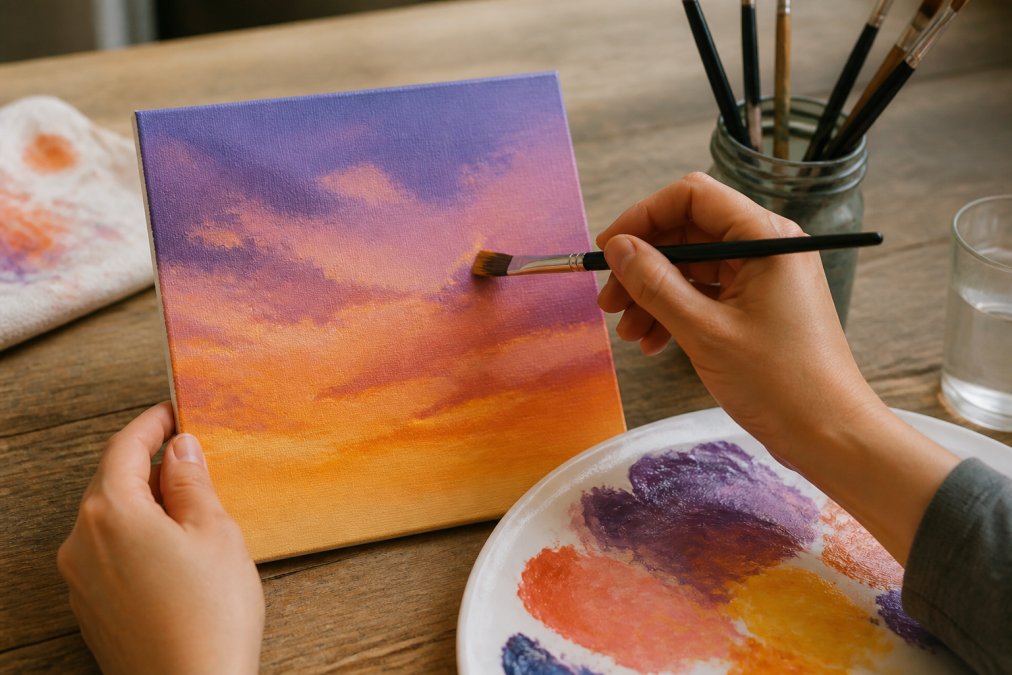
A night sky with stars is equally fast and adds stippling practice. Paint a dark blue or black background, let it dry, then use a small round brush to dot white stars. Add a crescent moon with a single curved stroke. Simple cloud studies and abstract color washes also fit this time frame. These 15-minute easy painting ideas are perfect for warming up before a longer session or for a quick creative break.
Weekend Easy Painting Ideas: Landscapes and Still Life That Teach Composition
With a few hours, you can tackle subjects that teach composition: landscapes and still life. A simple landscape with a horizon line, a distant mountain, and a foreground field introduces you to the rule of thirds and atmospheric perspective. Paint the sky first, then the mountains in a lighter blue, then the foreground in green, each layer drying before the next.
Still life painting builds observation skills. Arrange three objects with different shapes, like an apple, a mug, and a book, under a single light source. Sketch the basic shapes lightly with a pencil, then block in the darkest shadows first before layering mid-tones and highlights. These weekend easy painting ideas reward patience and give you time to correct mistakes between layers.
Easy Abstract Painting Ideas: Texture, Palette Knives, and Letting Go
Abstract art is the most forgiving category because there is no wrong answer. Instead of painting an object, you are arranging color, texture, and shape. A palette knife creates thick, satisfying texture that a brush cannot match. Load the knife with paint and drag it across the canvas in sweeping motions, or dab it to build peaks of color.
Complementary colors placed side by side create visual energy. Try layering a deep teal background with coral and gold accents. Geometric abstract pieces, like overlapping circles or blocks of color, teach you masking and edge control. These easy abstract painting ideas are ideal for paint and sip events because every guest finishes with a unique, gallery-worthy result regardless of skill level.
How Long Should a Beginner Painting Class Last? Structuring Your Session
For corporate team-building events or social gatherings, a two-hour session can feel substantial without dragging.
Structure the session in clear phases: 10 minutes for setup and introductions, 20 minutes for the initial sketch or background wash, 45 to 60 minutes for the main painting steps, and 15 minutes for finishing touches and cleanup. If you are hosting a paint and sip event, plan for guests to arrive 15 minutes early to settle in with their drinks before instruction begins.
Use a Painting Workshop Lesson Plan Template to Teach Without Stress
Teaching a painting class without a plan is a recipe for chaos. A painting workshop lesson plan template keeps you organized and your students successful. A strong template includes the project concept, a list of required colors, step-by-step instructions, time estimates for each phase, and troubleshooting notes for common mistakes.
| Session Phase | Duration | Key Activities | Beginner Outcome |
|---|---|---|---|
| Setup & Intro | 10 min | Supplies, demo of technique | Students feel prepared |
| Background & Sketch | 20 min | Wash technique, basic shapes | Canvas is no longer blank |
| Main Painting | 45-60 min | Layering, blending, details | Subject becomes recognizable |
| Finishing & Cleanup | 15 min | Highlights, varnish, wash brushes | Finished, dry painting |
This structure is exactly what PaintPrompt generates in seconds. Describe your class idea, and you receive a complete design with a 10-step guide, a color list, and a printable teaching plan. Whether you are a studio host planning a themed night or an instructor preparing a workshop, you can plan a full month of classes in minutes without guesswork. Generate your class design and never run out of ideas again.
Frequently Asked Questions
What is the easiest thing to paint as a beginner?
Sunsets and simple skies are the easiest subjects because they rely on blending two or three colors rather than drawing precise shapes. Start with a wash of light blue, add a warm orange or pink near the horizon, and soften the line where they meet. A silhouette of dark trees or a simple bird shape adds interest without needing fine detail. These projects also forgive mistakes, since clouds and color transitions look natural when slightly uneven.
What are 10 super easy painting ideas for beginners?
Try these subjects that hide imperfections well: 1) Sunset over water with a dark silhouette, 2) A single tree in a field, 3) Abstract color blocks with a palette knife, 4) A full moon with clouds passing across, 5) Simple floral stems in a jar, 6) A beach scene with basic wave lines, 7) A mountain range at dawn with layered colors, 8) A coffee mug on a table, 9) A butterfly with symmetrical wings, 10) A night sky with stars made by flicking white paint from a toothbrush.
What supplies do I need for beginner painting projects?
For your first few projects, buy a set of acrylic paints with the basics: titanium white, mars black, ultramarine blue, cadmium yellow, and a warm red. Grab three brushes: a flat 1-inch brush for washes, a round size 6 for details, and a small liner for thin lines. One 11x14 canvas or canvas pad is enough to start. You can skip gesso, medium, and varnish until you decide painting is a hobby you want to continue.
What is the 70/30 rule in painting?
The 70/30 rule guides your composition: let one dominant color or value cover about 70 percent of the canvas, and use the remaining 30 percent for contrast or a focal point. For example, in a sunset painting, the sky fills most of the canvas while the dark ground silhouette takes a smaller strip. This creates visual balance and prevents a chaotic, busy look. Beginners who follow this rule produce calmer, more professional compositions without needing formal design training.
How do you fix a painting mistake after the paint has dried?
Acrylic paint is forgiving because it layers well. If a section has dried and you want to change it, paint over it with two thin coats of titanium white, let them dry, and start that area again. For wet paint mistakes, wipe the area with a damp paper towel before it sets. When you need to remove texture, sand the dried paint gently with fine-grit sandpaper, wipe off the dust, and re-prime the spot with gesso.