7 Reasons Art Therapy Works for Corporate Team Bonding
· Editorial Team · 15 min read
Last Updated: October 24, 2026
Quick Summary
Art therapy is effective for corporate team bonding because a well-run creative group session can improve how people feel about each other during and shortly after the session. The bonding effect is strongest for teams with moderate trust and weakest for teams in active conflict, so treat claims of improved collaboration or productivity as hypotheses to test.
- A workday session should fit in 60 to 90 minutes, including setup and cleanup.
- The bonding effect is stronger when participation is voluntary.
- Spend five minutes on a debrief asking what people noticed.
- Use a pre/post survey with the same people rather than a single survey.
- Re-survey two to four weeks later to track retention of the effect.
Table of Contents
- What Art Therapy Is and How It Works in a Group Setting
- Why Art Therapy Supports Corporate Team Bonding
- Corporate Art Therapy Activities That Fit a Workday
- Group Art Therapy Exercises for Communication and Collaboration
- Art Therapy vs. Art Classes: What Organizers Need to Know
- How to Run a Guided Painting Activity for Teams Step by Step
- Measuring Outcomes and Deciding If It Worked
- Plan Your Next Team Painting Session
- Frequently Asked Questions
What Art Therapy Is and How It Works in a Group Setting
Art therapy is a mental health practice that uses making art to help people express feelings, process stress, and connect with others under the guidance of a trained facilitator. In a group setting, everyone creates at the same time, then shares as much or as little as they want.
The key distinction: art therapy is not about making a good picture. The paint, clay, or collage becomes a way to say something you might not have words for.
A group art therapy session usually follows a simple shape:
- A short check-in to set the tone
- A guided creative activity with a clear prompt
- Time to work without interruption
This guide covers why the format works for workplace teams, what to run, and how to tell if it worked.
Why Art Therapy Supports Corporate Team Bonding
The evidence for art therapy improving team bonding is promising but thin.
What the evidence actually supports
Art therapy has a reasonable research base for reducing anxiety and improving mood in groups. The American Art Therapy Association describes it as a mental health profession in which licensed, credentialed art therapists use the creative process within a therapeutic relationship (About Art Therapy).
For workplace outcomes, cohesion, communication, psychological safety, direct evidence is much thinner. Creative group activities improve self-reported mood and perceived social connection short term, but effects on durable team performance are rarely measured. Treat claims of improved collaboration or productivity as hypotheses to test.
The mechanisms that plausibly explain bonding
Several mechanisms explain why these sessions feel effective:
- Shared attention on a non-work task. Focusing on the same activity lets status hierarchy recede, so people interact as people rather than job titles.
- Low-stakes vulnerability. Making something imperfect in front of colleagues, with judgment removed, signals it is safe to be a beginner, a small but real test of psychological safety.
- Conversation scaffolding. A shared object on the table gives people something to talk about that is not work or small talk, reducing awkwardness.
Where the effect is strongest and weakest
Practitioners report the bonding effect is strongest for teams with moderate trust and weakest for teams in active conflict. A single session will not repair a broken team, and the effect is stronger when participation is voluntary.
The distinction that changes the claim
If a licensed art therapist leads the session, you can describe it as art therapy and lean on the clinical evidence base, with caveats. If a trained host without clinical credentials leads it, describe it as a guided creative workshop. The bonding mechanisms still apply, but the clinical claims do not.
Stress reduction and emotional well-being
Focused creative work gives the brain a break from work tasks. The rhythm of painting, mixing color, and filling space is calming, especially away from desks and screens.
Shared experience and social connection
A shared experience builds social connection faster than a happy hour because everyone has something in front of them to talk about. Natural conversation starters emerge: "How did you get that color?" Teams leave with a story and a painting, more memorable than small talk.
Corporate Art Therapy Activities That Fit a Workday
The best corporate art therapy activities are short, simple, and need no prior art skills. A workday session should fit in 60 to 90 minutes, including setup and cleanup.
Here is what works well for teams:
- Guided painting: Everyone follows the same steps toward a finished piece. Best for mixed groups.
- Collaborative mural: Each person paints one panel of a larger image. Great for collaboration.
- Blind contour drawing: Draw a partner without looking at the paper. Fast, funny, and disarming.
For ready-made designs with simple teaching steps, you can generate original paint and sip designs on demand. Each one comes with a color list and a printable sheet your whole group can follow.
Group Art Therapy Exercises for Communication and Collaboration
Group art therapy exercises build communication because they force small, low-stakes decisions together. Nobody argues about a painting the way they argue about a budget.
Try these group art therapy exercises with your team:
- Round-robin painting: Each person starts a canvas, then passes it every few minutes. The group finishes each piece together.
- Two-person one-brush: Pairs share a single brush and one color palette. They must talk to coordinate.
- Prompt swap: Everyone writes a one-line prompt, then draws a stranger's prompt from a hat.
A common mistake is skipping the debrief. Spend five minutes asking what people noticed. That conversation is where the team insight lives.
Art Therapy vs. Art Classes: What Organizers Need to Know
Art therapy and art classes look similar but serve different goals. An art class teaches technique and aims at a polished result. Art therapy uses the creative process for emotional expression, insight, and healing.
Here is the comparison that matters when you plan:
| Feature | Art Therapy Session | Art Class |
|---|---|---|
| Main goal | Expression and connection | Skill and technique |
| Focus | The process | The finished piece |
| Facilitator | Trained therapist or guided host | Instructor teaching methods |
| Sharing | Optional, feelings-focused | Critique of the work |
| Best for teams | Bonding and stress relief | Learning a specific skill |
Watch out: calling a recreational workshop "therapy" can mislead people and cross ethical lines. If no licensed therapist leads the session, describe it as a guided creative workshop.
How to Run a Guided Painting Activity for Teams Step by Step
A guided painting activity for teams works best when you plan the design, timing, and setup before the day. Here is the sequence we recommend.
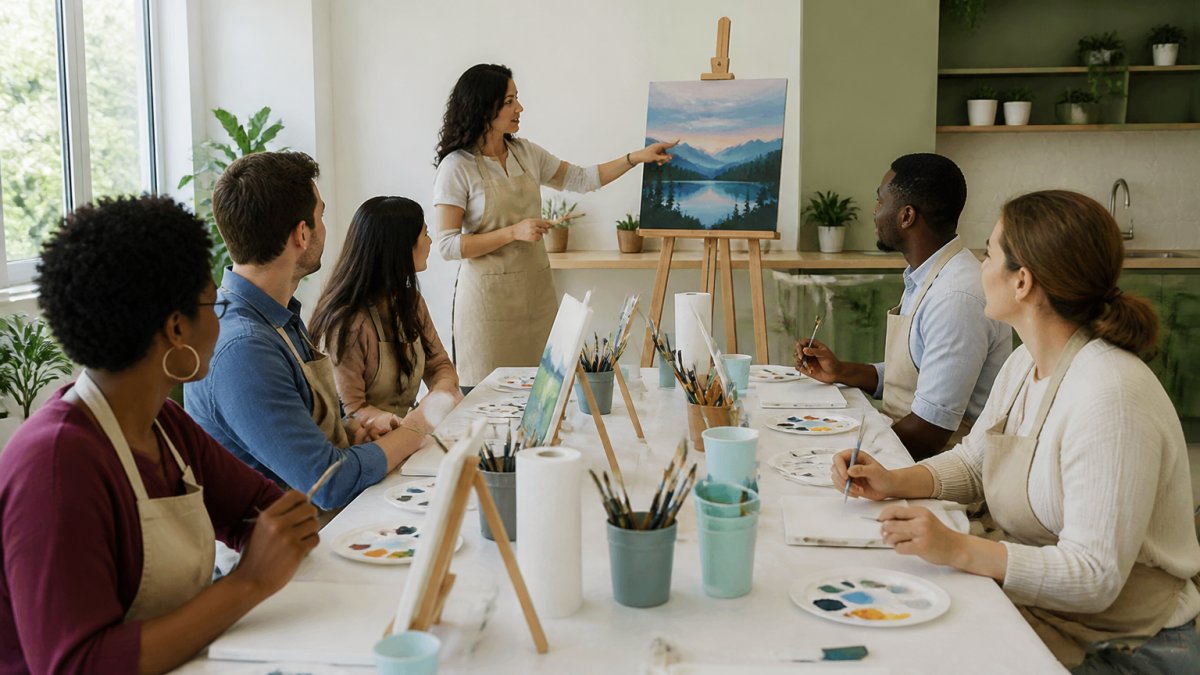
- Pick a design everyone can finish. Choose a beginner-friendly composition with big shapes and few colors.
- Set the room. Long tables, one canvas per person, shared water cups, and a sample painting up front.
- Open with a two-minute welcome. Explain that there is no wrong way to paint.
- Demonstrate one step at a time. Paint it yourself, then let the group catch up.
- Build in a break. Ten minutes halfway through keeps energy up.
- Do a share-out. Ask for one word about the experience, not a critique.
- Wrap with a takeaway. Everyone leaves with their painting and a short reflection card.
For help choosing team-friendly canvas designs and structuring the timing, see this guide on managing designs and timing for corporate paint and sip.
Creating a Safe, Nonjudgmental Environment
A safe space starts with what the facilitator says in the first two minutes. State plainly that no one will be judged and that sharing is optional. Then model it: show your own imperfect work.
A few rules that help:
- No comparing paintings out loud
- No "I'm so bad at this" talk
- Praise effort, not accuracy
Psychological safety is the whole point. If people feel judged, they shut down, and the bonding never happens.
Adapting for Hybrid Teams and All Skill Levels
Hybrid teams need identical materials and clear steps.
For skill levels, mix beginners and experienced painters on purpose, pairing them so beginners get quiet help without feeling singled out.
If you want pacing and rescue techniques so every beginner succeeds, read this guide on teaching beginner paint and sip with pacing and rescues.
Measuring Outcomes and Deciding If It Worked
Most organizers either skip measurement or rely on a vibe check. Neither is defensible when you are asking for budget. Here is a lightweight but credible way to measure a session.
Start with a pre/post design, not a single survey
The minimum credible design is a short anonymous survey administered immediately before and after the session, using a consistent scale. Comparing the same people to themselves controls for teams that start out more connected than others.
A practical scale is a five-point agreement scale (1 = strongly disagree, 5 = strongly agree). Ask the same items both times.
Use validated instruments where you can
You do not need a research team, but borrow from tested instruments rather than inventing questions:
- Psychological safety: Edmondson's psychological safety scale is the standard in team research and short enough for a workplace survey. It asks whether it is safe to take a risk on this team and whether mistakes are held against people.
- Belonging: The sense-of-belonging items used in workplace well-being research, or a short belonging subscale, are more defensible than a single homemade question.
- Stress: A brief perceived-stress measure, or a single validated stress item, is adequate for a pre/post snapshot. Avoid inventing your own stress scale if you plan to report the results to leadership.
If you cannot use a validated instrument, say so when you report results. "Self-reported, non-validated" is an honest label that protects your credibility.
What to measure beyond self-report
Self-report is the core, but a few behavioral indicators add texture:
- Participation rate: the share of invited employees who attended and completed a piece.
- Debrief engagement: how many people shared during the reflection, and whether sharing was voluntary.
- Cross-team interaction: whether people talked to colleagues outside their usual working group. A simple observation count or a post-session question ("Did you talk with someone you don't usually work with?") captures this.
Interpreting results without overstating causality
One session is a snapshot, not proof. A pre/post shift can be caused by the session, the novelty of being out of the office, the facilitator's energy, or simply a break from routine. Do not attribute a rise in connection scores to the art activity alone.
To get closer to a real signal:
- Repeat across sessions. If connection scores climb consistently across several events, the pattern is more credible than any single result.
- Use a comparison group where feasible. If only part of a department attends, compare the attendees' post-session scores to non-attendees' scores on the same items at the same time. This is not a randomized trial, but it rules out some alternative explanations.
- Track retention of the effect. Re-survey two to four weeks later. A bonding effect that vanishes by the next Monday is still real, but it is not the durable outcome leadership is usually paying for.
A simple ROI framing
ROI for a team-bonding session is hard to calculate honestly, so frame it as a decision aid. Compare the fully loaded cost, facilitator time, materials, room, and employee hours, against what you measured: participation, debrief engagement, cross-team interaction, and the size and durability of the pre/post shift. If connection scores rise and hold at follow-up, you have a defensible case to repeat; if flat, you have saved the cost of scaling a program that is not working.
What good looks like
A session that worked shows a meaningful pre/post rise on connection and psychological safety items, high voluntary participation, visible cross-team conversation, and a follow-up score that has not fully decayed. A session that did not work shows a pleasant mood bump that fades within days and no change in who talks to whom.
Plan Your Next Team Painting Session
The hardest part of a corporate art session is the planning: choosing a design, writing the steps, and making sure beginners can finish. For a full walkthrough, see this guide to planning corporate team building painting.
PaintPrompt was built by real paint and sip hosts to remove that work.
Dana R., who runs themed nights at a studio, put it this way: "A new design and instructions in under a minute."
Ready to stop guessing and start painting? Get started with PaintPrompt and turn your next team event into a session everyone finishes and remembers.
Frequently Asked Questions
Can art therapy help coworkers communicate and connect?
Yes, when it is run as a facilitated group session rather than a free-for-all craft hour. A trained facilitator sets ground rules, guides a short warm-up, and leads a debrief where people describe what they made and what they noticed. That structure gives quieter employees a way into the conversation and gives the group a shared experience to reference afterward. The connection comes from the facilitated discussion and the shared activity, not from the quality of anyone's painting.
What is the difference between art therapy and a corporate art class?
An art class teaches technique and aims at a finished, presentable piece. Art therapy is led by a licensed mental health professional and focuses on the process, emotional expression, and reflection, with no expectation of a polished result. For team bonding, the two can overlap: a guided painting activity delivered by an instructor builds shared experience and morale, while a clinical art therapy session adds a therapeutic goal and a qualified facilitator. Match the format to what your team actually needs.
How long should a corporate team art activity last?
Plan for 60 to 90 minutes for a guided painting session. That covers a short welcome and ground rules, 45 to 60 minutes of painting, and 10 to 15 minutes of reflection or debrief. Sessions under 45 minutes tend to feel rushed and leave people frustrated with unfinished work. If you are adding a clinical art therapy component, allow 90 minutes so the facilitator has room for a proper opening and closing.
Do employees need art skills to take part?
No. Choose a composition built from simple shapes and clear steps so beginners can finish something they are happy with. Provide a printed step guide and a color list for each participant, and tell the group up front that the goal is participation, not a masterpiece. When everyone starts from the same guided design, the people with no art background are not left behind, and the group finishes together.
