Planning Corporate Team Building Painting in 2026
· Editorial Team · 11 min read
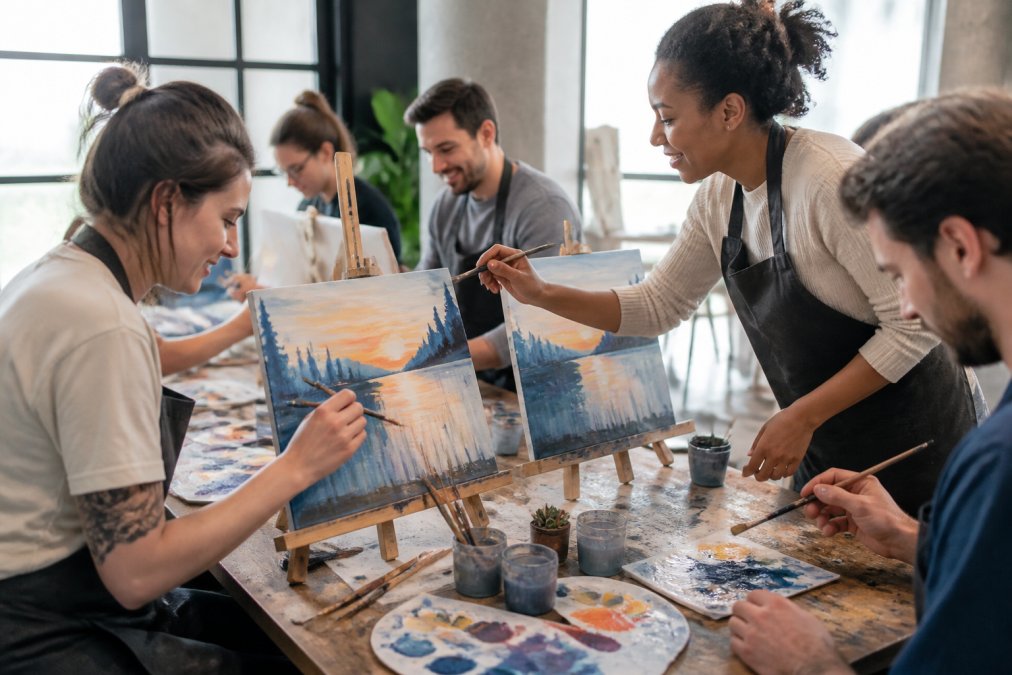
Table of Contents
- Why Corporate Team Building Painting Beats Standard Icebreakers
- Corporate Paint and Sip Ideas That Work for Any Group Size
- How Long Should a Team Building Painting Activity Duration Be?
- The Complete Painting Workshop Supply List for Corporate Events
- How to Plan Paint and Sip Classes That Fit Your Budget
- Accessibility and Inclusivity: Making Painting Work for Every Employee
- Common Mistakes When Planning Corporate Team Building Painting
- Conclusion
- Frequently Asked Questions
Last Updated: September 24, 2026
Why Corporate Team Building Painting Beats Standard Icebreakers
Planning corporate team building painting events has become a genuine alternative to the trust fall and the awkward two-truths-and-a-lie game. According to SHRM's research on team building, employers that invest in structured creative activities report stronger group rapport than those relying on generic icebreakers. Event planners now ask for a facilitated painting session the way they used to ask for a bowling night. The reason is simple.
The measurable ROI of a creative workshop
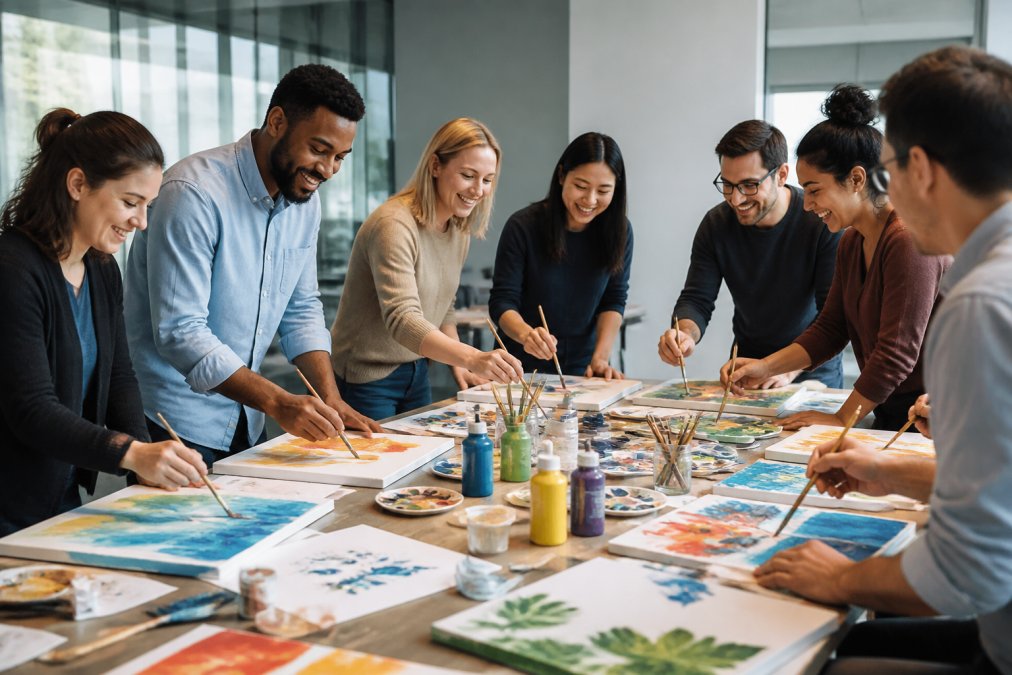
ROI on a team event rarely shows up on a spreadsheet the way a software license does. What you can measure is participation, retention of new hires, and internal referral rates. A common approach is to survey attendees before and after, asking them to rate how well they know three colleagues by name and role. Teams that run quarterly creative workshops tend to see those familiarity scores climb.
How painting improves team morale and communication skills
Painting forces low-stakes communication. Someone has to ask for the blue paint. Someone has to negotiate canvas space during a collaborative artwork. These small exchanges build group rapport without the pressure of a formal feedback session. Many facilitators find that quieter team members speak up more during a painting session than in a standard meeting, because the activity gives them something concrete to talk about.
Corporate Paint and Sip Ideas That Work for Any Group Size
Corporate paint and sip ideas scale from six people in a break room to two hundred at an offsite. The format that fits depends on your space, your budget, and whether your group is in one room or scattered across time zones. Below are the formats we see work most often, with the trade-offs for each.
Themed sessions: from abstract landscapes to collaborative canvas projects
Themed sessions give the group a shared reference point. Abstract landscapes work well for mixed-skill groups because there is no wrong answer. Collaborative canvas projects, where each person paints one panel of a larger image, create a finished piece the team can hang in the office. Icebreaker formats work best for new teams; skill-building formats suit groups that already know each other and want a challenge.
Virtual vs. in-person painting sessions for hybrid teams
Virtual workshops solve the hybrid-team problem, but they need more prep. Every remote participant needs a supply kit shipped ahead of time, a camera angle that shows their canvas, and a facilitator who can watch multiple screens at once. In-person sessions are easier to run and create more spontaneous conversation. For hybrid teams, the practical answer is often a facilitated in-person session for those who can attend, paired with a virtual workshop for remote colleagues on a separate date.
| Format | Best For | Setup Effort | Group Size |
|---|---|---|---|
| In-person facilitated | Local teams, offsites | Medium | 6-200 |
| Virtual workshop | Distributed teams | High (shipping) | 5-50 |
| Hybrid split | Mixed attendance | High | 10-100 |
| DIY kits | Tight budgets | Low | Any |
How Long Should a Team Building Painting Activity Duration Be?
The ideal team building painting activity duration is 90 minutes to 2 hours for most corporate groups. That window gives enough time for setup, instruction, painting, and a short wrap-up without losing momentum. Sessions shorter than 75 minutes feel rushed; sessions longer than 2.5 hours start to lose people who have other commitments.
Timing breakdown for a 90-minute vs. 2-hour session
A 90-minute session typically runs: 10 minutes for arrival and supplies, 15 minutes for instruction and color mixing, 50 minutes for painting, and 15 minutes for cleanup and photos. A 2-hour session adds a longer instruction block and a proper break, which suits larger groups or more complex designs. If you are planning corporate team building painting for a group over 30, budget the longer option.
The Complete Painting Workshop Supply List for Corporate Events
A painting workshop supply list for a corporate event covers canvases, acrylic paint, brushes, palettes, water cups, aprons, and table coverings. The split between what you provide and what the venue supplies depends on whether you are booking a studio or running the session in your own space.
What to provide vs. what the venue supplies
If you book a dedicated studio, they usually handle easels, tables, cleanup, and sometimes aprons. You bring the headcount and the design. If you run the event in your office or a rented conference room, you own the full list. The items people forget most often are table coverings, paper towels, and enough water cups. Buy more than you think you need.
- Canvases (one per person, plus two spares)
- Acrylic paint sets in primary colors plus white and black
- Assorted brush sizes (flat and round)
- Paper plates or palettes for mixing
- Water cups and paper towels
- Aprons or old shirts
- Table coverings and trash bags
How to Plan Paint and Sip Classes That Fit Your Budget
Learning how to plan paint and sip classes on a fixed budget comes down to one decision: DIY kits or a facilitated event. DIY kits cost less per person but shift the teaching burden onto someone on your team. Facilitated events cost more but remove the prep work and usually produce better finished paintings.
Cost-benefit analysis: DIY kits vs. facilitated events
DIY kits make sense for small teams with a confident in-house instructor and a tight budget. Facilitated events make sense when you want a guaranteed outcome and no internal prep time. The hidden cost of DIY is the hours someone on your team spends sourcing supplies, writing instructions, and troubleshooting during the session. When you count those hours, the gap between the two options narrows fast.
Accessibility and Inclusivity: Making Painting Work for Every Employee
Accessibility is the part most corporate painting guides skip, and it is the part that determines whether the event actually includes everyone. Not every employee can stand at an easel for an hour, hold a thin brush, or process verbal instructions in a noisy room. Plan for those needs before the event, not during it.
- Offer seated table space as an option, not a fallback
- Provide thicker-grip brushes and larger canvases
- Print written step-by-step instructions alongside the live demo
- Choose low-scent paints for scent-sensitive attendees
- Keep the room quiet enough for people who struggle with background noise
- Avoid alcohol-centric framing if the event is during work hours
Common Mistakes When Planning Corporate Team Building Painting
The biggest mistake is treating the event as a party rather than a facilitated session. A party needs snacks and a room. A session needs a design, a facilitator, and a plan for what happens when someone falls behind.
Other mistakes we see often:
- Choosing a design that is too complex for a mixed-skill group
- Skipping the supply check and running short on paint or brushes
- Forgetting to assign someone to take photos
- Scheduling the event at the end of a long day when energy is low
- Not sending a calendar hold with clear start and end times
Conclusion
Planning corporate team building painting that people actually enjoy takes more than booking a room and buying canvases. It takes a tested design, a clear timeline, and a supply list that covers the details most planners forget.
Frequently Asked Questions
What are the benefits of painting for corporate team building?
Painting events improve team morale, communication skills, and group rapport by removing the pressure of typical corporate outings. Employees engage in creative expression without needing art experience, which lowers social barriers. The shared goal of completing a canvas collaboration encourages problem-solving and team synergy. Many HR leaders report higher employee engagement and stress reduction after a facilitated painting workshop compared to standard icebreakers.
How long should a corporate painting team building session last?
Most successful events run between 90 minutes and 2 hours. A 90-minute session works well for beginner-friendly designs and virtual workshops, while 2 hours allows for more complex collaborative artwork and a longer social break. If you include setup and cleanup, plan for an extra 30 minutes. For hybrid teams, keep the painting activity to 60 minutes and add a separate 15-minute virtual debrief.
What supplies are needed for a corporate team building painting workshop?
A standard painting workshop supply list includes canvases (one per person or per small group), acrylic paint sets, assorted brushes, disposable palettes, water cups, aprons or old shirts, table covers, and paper towels. For virtual sessions, you will also need individual supply kits shipped to each employee's home. If you hire an artist-led facilitator, they often bring all materials, but confirm whether the venue provides easels and tables.
Can painting activities be adapted for virtual team building?
Yes. Virtual painting workshops work best when you ship identical supply kits to each participant and use a video platform with breakout rooms. Choose simpler designs that can be completed in 45 to 60 minutes. A facilitator guides the group step by step, and remote collaboration tools let teammates share progress. Hybrid teams can combine in-person groups with remote participants by having one camera focused on the instructor's canvas.
How do you choose the right painting theme for a corporate group?
Match the theme to your team's interests and the event goal. For stress reduction, choose abstract or nature scenes. For communication skills, use a collaborative canvas where each person paints one section. For a seasonal corporate outing, pick holiday or company-milestone themes. Always select beginner-friendly compositions with clear shapes and limited colors so everyone can finish successfully, regardless of art experience.
Most teams run into the same wall: the design work eats the time you saved by skipping a formal facilitator. PaintPrompt solves that. You describe the painting you want, and PaintPrompt generates a class-ready design with 10-step instructions, a full color list, and a printable teaching guide you can hand to every guest. It is built by real paint and sip hosts, so the compositions actually work in a live room. Get started with PaintPrompt and plan a full month of team sessions in an afternoon.