How to Plan a Paint and Sip Class: 2026 Guide
· Editorial Team · 16 min read
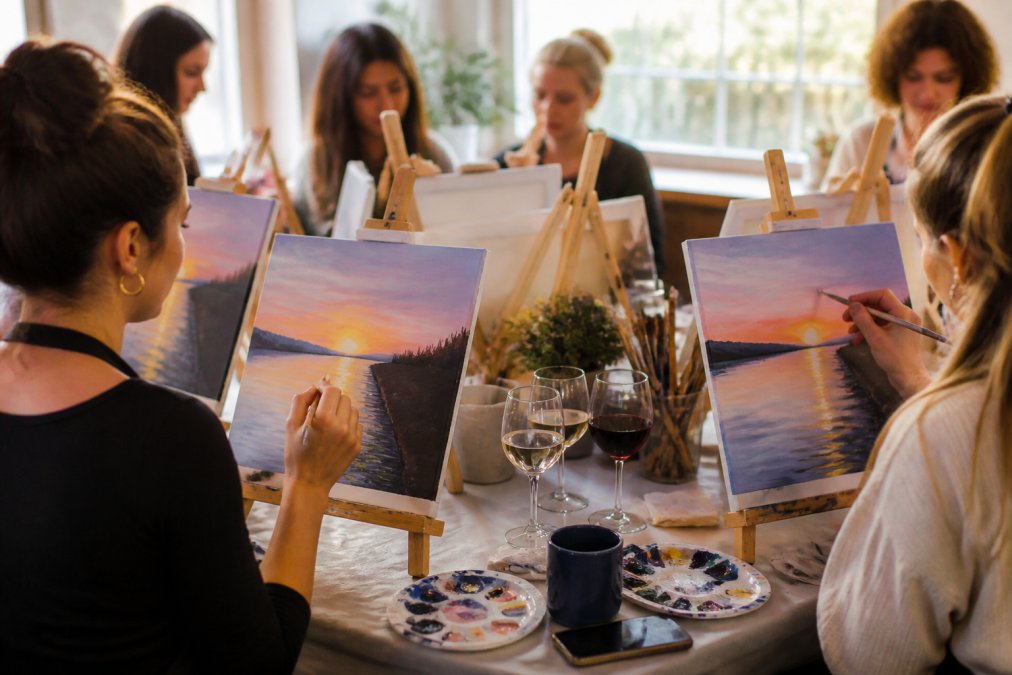
Table of Contents
- What You'll Need to Plan a Paint and Sip Class
- The Complete Paint and Sip Supply List
- How Long Should a Paint and Sip Class Run?
- How to Price Paint and Sip Events for Profit
- Legal Requirements for Paint and Sip Businesses
- Choosing a Theme and Designing the Painting
- Marketing Your Paint and Sip Class and Selling Tickets
- Frequently Asked Questions
Last Updated: September 14, 2026
What You'll Need to Plan a Paint and Sip Class
Planning a paint and sip class starts with three decisions: when you'll host it, where it will happen, and what guests will actually paint. Get those locked in and the rest of the logistics fall into place quickly.
This guide covers the full process, from your first supply list to pricing for profit and staying compliant with local regulations.
A paint and sip class is a social painting event where guests follow step-by-step instruction to complete a single painting while enjoying drinks and conversation. It works because the instruction is structured, the subject is achievable in one sitting, and nobody needs prior experience.
Most first-time hosts underestimate how much of the job is logistics rather than art.
Choosing a Date, Time, and Venue
Pick a date at least three weeks out. Weekday evenings suit smaller groups; weekend afternoons draw bigger crowds and families.
For venue selection, you have three realistic options:
- Your own studio or home: Lowest cost, but you're responsible for tables, lighting, water access, and cleanup.
- A rented space: Community halls, breweries, and restaurants often rent rooms during off-peak hours. Confirm whether they allow outside food and drink.
- A client's location: Corporate offices and private homes. You bring everything, including floor coverings and table protection.
Whatever you choose, check the lighting first. Bad overhead lighting makes color mixing harder and photos worse, so aim for natural light or bring portable lamps.
Building a Simple Planning Checklist
A tight checklist keeps you from scrambling the week of the event:
- Confirm date, time, and venue in writing
- Set your guest cap based on table space
- Choose the painting and generate your step-by-step guide
- Order or restock supplies two weeks ahead
- Set up ticketing and share the event link
- Confirm any required permits or insurance
- Send a reminder to guests 48 hours before
- Prep stations the morning of the event
The Complete Paint and Sip Supply List
A complete paint and sip supply list covers five categories: surfaces, paint, tools, protection, and comfort. Skipping any one shows up as a problem mid-class.
Surfaces and support:
- One canvas per guest, sized 11x14 inches or 12x12 inches for beginners
- Easels or tabletop stands, one per guest
- A finished sample painting for reference
Paint and tools:
- Acrylic paint in a limited palette: white, black, red, yellow, blue, and one or two earth tones
- Flat and round brushes in two or three sizes per guest
- Paper plates or plastic palettes for color mixing
- Water cups, one per two guests
- Paper towels or rags
Protection and comfort:
- Aprons or old shirts for every guest
- Plastic table covers or drop cloths
- Disposable gloves if you're working with younger painters
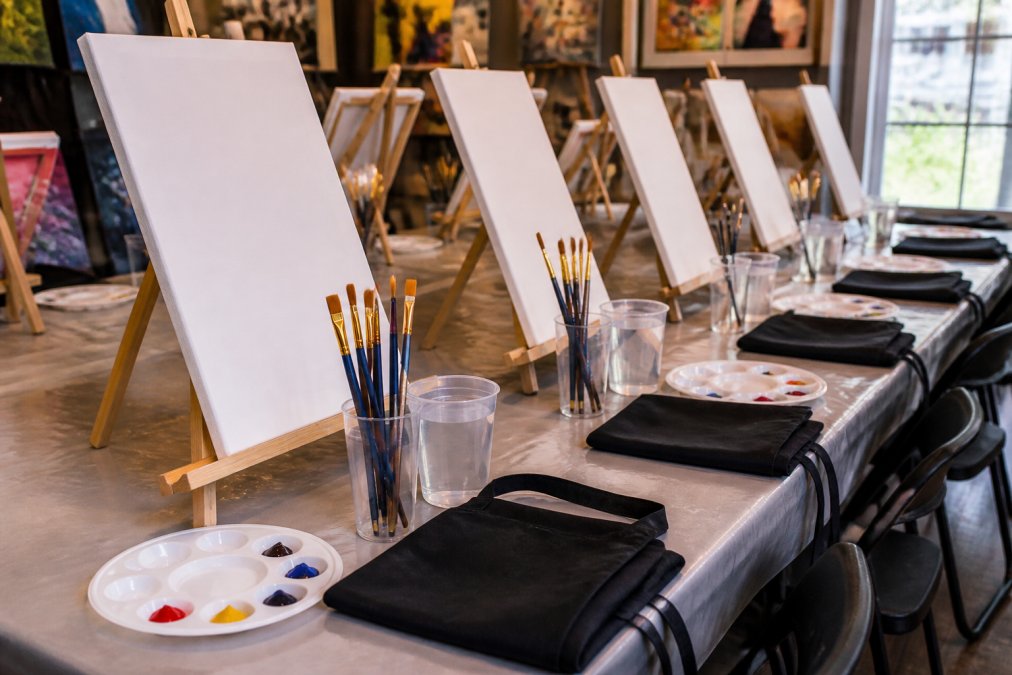
Buying in bulk keeps per-guest costs down, and reusable items like easels, palettes, and aprons pay for themselves after a few events.
Table Setup and Station Layout
Set each station with everything a guest needs within arm's reach. A canvas on an easel, a palette with the night's colors already squeezed out, two brushes, a water cup, and a rag. Pre-portioning paint before guests arrive cuts the first ten minutes of chaos dramatically.
Leave walking space between tables so guests can step back to view their work and you can move between stations to help.
How Long Should a Paint and Sip Class Run?
A typical paint and sip class runs two to three hours, including setup, instruction, and a break (eventbrite.com). Two hours suits a simple composition with a limited palette; three hours allows a more detailed painting and slower painters.
Structure the time like this:
| Phase | Duration | What Happens |
|---|---|---|
| Arrival and settle-in | 15-20 min | Guests get drinks, find seats, put on aprons |
| Blocking in the composition | 20-30 min | Sketch the main shapes, lay down base colors |
| Main painting instruction | 45-60 min | Work through the steps together |
| Break | 10-15 min | Drinks, photos, socializing |
| Details and finishing | 20-30 min | Highlights, edges, signature |
| Cleanup and photos | 15 min | Pack up, group photo, take paintings home |
Beginners consistently underestimate how long color mixing takes. Build in buffer time rather than rushing the final steps, since a rushed finish looks unfinished.
How to Price Paint and Sip Events for Profit
Pricing a paint and sip event starts with your true cost per guest, then adds your margin. Many hosts price on gut feel and discover months later they've been breaking even.
Calculate your cost per guest first:
- Canvas and paint: your per-unit supply cost
- Brushes and consumables: amortized across uses
- Venue rental: divided by your guest count
- Instruction time: your hourly rate multiplied by class length
- Marketing and ticketing fees: a small percentage of each sale
Once you know that number, set your ticket price at roughly two to three times your cost per guest. That range leaves room for events that run under capacity, which will happen.
A few pricing levers worth knowing:
- Private events typically command a higher per-head rate than public classes because of the convenience and customization.
- Corporate bookings often pay a flat fee for the group rather than per person.
- Package deals for recurring guests can improve retention without discounting single tickets.
Legal Requirements for Paint and Sip Businesses
Legal requirements for paint and sip businesses vary by state and city, but most operators must address four areas: business licensing, alcohol rules, insurance, and food handling if you serve anything beyond packaged snacks.
Business licensing: Register your business entity and check whether your state or city requires a general business license or a specific amusement or entertainment permit.
Alcohol: This is the biggest variable. If you serve alcohol, you generally need a liquor license or must work with a licensed venue or caterer. Many studios partner with a licensed bar rather than hold their own license. Check your state's alcohol control board for the rules that apply to you.
Insurance: General liability coverage protects you if a guest is injured or damages property. If you serve alcohol, ask your insurer specifically about liquor liability, since standard policies often exclude it.
Food handling: If you prepare or serve food beyond sealed packaged items, your local health department may require a food handler's permit.
Because these rules differ so much by location, confirm the specifics with your state and local agencies before your first paid event. The U.S. Small Business Administration's licensing guide walks through the general registration steps, and your state's alcohol control board publishes the rules for serving drinks at events.
Choosing a Theme and Designing the Painting
The painting you choose determines whether guests leave happy. A good class painting has a clear focal point, a limited palette, and repeatable steps beginners can follow.
Themes that consistently work:
- Seasonal subjects: pumpkins in fall, beach scenes in summer
- Simple landscapes: sunsets, mountains, and fields
- Bold abstracts: geometric shapes and color-blocked designs
- Themed nights: couples' paintings, pet portraits, holiday designs
What most guides miss is that design difficulty, not theme, makes or breaks a class. A gorgeous reference image with twelve colors and fine detail frustrates beginners; a simpler composition with strong shapes and four colors has everyone finishing successfully.
The Design Rules That Keep Beginners Finishing
Before you commit to a painting, run it through these constraints. They are the difference between everyone leaving with a finished canvas and half the room still blending sky when the venue closes.
- Cap the palette at four to six colors. Every additional color adds mixing time and a new way for a beginner to muddy a section. A workable starter set is white, black, red, yellow, blue, and one earth tone.
- Limit the painting to roughly 10 to 14 discrete steps. Fewer than 10 and guests finish early and lose momentum; more than 14 and slower painters fall behind and stop following along.
- Budget about 8 to 12 minutes per step. Multiply your step count by that range and compare it to your class length. A 12-step painting at 10 minutes per step is a two-hour class before you add the break.
- Give every step a visible payoff. Beginners stay engaged when each instruction changes something they can see. "Add a thin white line along the horizon" reads better than "adjust your values."
- Design one focal point. A single sun, tree, or mountain that draws the eye lets guests know when the painting is done, which matters more than you'd expect for people who have never finished a canvas.
Building the Step-by-Step Guide
A class-ready design is really a teaching document. Whether you write it yourself or generate it, the guide should include:
- A finished reference image at the size guests will paint
- A color list with the exact mixes for each area (for example, "sky: white + a touch of blue + a dot of red")
- Numbered steps written in plain language, one action per step
- A note on which brush to use for each step
- A suggested timing marker so you know where you should be at the halfway point
Experienced hosts often paint the design themselves once, timed, before teaching it. If a step takes you four minutes, budget eight to ten for a room of beginners. That dry run catches the steps that sound simple but aren't.
Matching the Design to the Group
- Public classes with mixed skill levels: choose the simplest version of the design and offer an optional "challenge layer" (extra highlights, a second tree) for guests who finish early.
- Couples' or date-night events: two canvases that combine into one image work well, but keep each half independently finishable so neither guest feels behind.
- Corporate groups: favor bold, graphic designs with large color blocks. They photograph well, tolerate uneven skill levels, and finish reliably inside a two-hour window.
- Kids' events: drop to three or four colors and eight or fewer steps, and pre-draw the main shapes in light pencil so younger painters have a guide.
This is where a tool like PaintPrompt changes the workflow. Instead of hunting for reference images and reverse-engineering steps, you describe the idea you want and get back a class-ready design with a 10-step guide, a color list, and a printable teaching plan. Hosts who run recurring events can plan a full month of classes in minutes rather than an afternoon.
Marketing Your Paint and Sip Class and Selling Tickets
Most paint and sip guides stop at "post on social media." That advice doesn't fill seats. Selling tickets comes down to three things: a clear event page, a reason to book now, and a way for guests to share the event.
Build the Event Page Before You Promote Anything
Your event page needs the painting image, date and time, location, price, and what's included. Guests want to know whether drinks are provided, whether supplies are covered, and what to wear. Answer those on the page and you'll cut down on messages.
A few specifics that move conversion:
- Lead with the finished painting, not the venue. Guests are buying the painting they'll take home.
- State the class length and skill level. "Two hours, no experience needed" removes the two biggest objections.
- Show the refund and transfer policy. A clear policy reduces hesitation and cuts down on no-shows.
- Add a group option. A visible "book 6 or more" price gives friend groups a reason to commit together.
Choose a Ticketing Platform That Fits Your Volume
You don't need enterprise software to sell 20 seats. The practical options fall into three buckets:
- General event platforms: good for discovery, since people already browse them for local things to do. They take a per-ticket fee, so factor that into your price.
- Payment processors with a checkout link: lowest fees, but you handle the guest list and reminders yourself.
- Your own site with a booking plugin: best for hosts running recurring classes who want repeat customers on their own list.
Whichever you pick, keep one rule: the platform should send an automatic confirmation and a reminder. Manual reminders don't scale past a class or two a month.
Understand the Sales Curve
Most public classes sell the bulk of their tickets in the final week, and a meaningful share in the last 48 hours. That pattern is normal, not a sign your event is failing. Plan around it:
- Weeks 3-4 out: announce to your email list and past guests first. They convert best.
- Weeks 1-2 out: push the process video and any partnership cross-posts.
- Final week: post daily, and consider a small "last few seats" nudge only if it's true.
- Day before: send the reminder with parking and arrival details. This is also your best chance to reduce no-shows.
Don't panic-cancel a class because early sales are slow. Do set a minimum headcount in advance so you know your break-even point before you decide.
Promotion Channels That Actually Convert
- Social media: post the finished painting as a short video showing the steps. Process content outperforms a static image almost every time. Post the same painting three or four times across the sales window rather than once.
- Email: past guests are your best source of repeat bookings. Send the next month's schedule before you promote it publicly.
- Partnerships: local bars, cafes, and community groups will promote your event if you make it easy for them. Give them a ready-made post, an image, and a unique link so you can see what worked.
- Corporate outreach: team-building coordinators book repeatedly once they've had a good experience. One corporate client can fill several dates. Reach out to office managers and HR coordinators directly, and offer a flat group rate rather than per-head pricing.
Turn One Booking Into a Repeat Customer
Filling seats once is a campaign. Filling them every month is a system:
- Capture emails at the event, not just at checkout. A sign-in sheet or a QR code on each table works.
- Photograph the group and send the images the next day with a link to the next class.
- Offer a package for guests who want to come back, which improves retention without discounting single tickets.
- Ask corporate clients for a follow-up date before they leave the room, while the experience is fresh.
SCORE's small business marketing resources offers free templates for event promotion if you're building your marketing from scratch.
Frequently Asked Questions
What supplies are essential for a paint and sip event?
Every paint and sip class needs stretched canvases, acrylic paint in a limited palette, flat and round brushes, paper plates or palettes for mixing, water cups, paper towels, and aprons. Add table covers, easels or tabletop stands, and a printed step-by-step guide for each guest. Keep the color list short, four to six colors, so beginners can mix without confusion and finish their painting in one session.
Do you need a liquor license to host a paint and sip event?
It depends on how alcohol is handled. If you sell or serve alcohol, most states require a liquor license or a specific permit, and some states add rules for art studios. If guests bring their own wine, many states allow it, but local rules vary and some cities require a permit anyway. Check your state alcohol board and city business office before your first event, and confirm whether your liability insurance covers alcohol-related incidents.
How do you structure the timing of a paint and sip workshop?
Plan a two-hour class as follows: 15 minutes for arrival, drinks, and aprons; 10 minutes for a demo of color mixing and brush techniques; 75 minutes for guided step-by-step painting; and 20 minutes for finishing touches, photos, and cleanup. A three-hour event adds a longer social break. Keep instruction blocks under 10 minutes so guests stay engaged and the group finishes together.
What are the best themes for a paint and sip program?
Themes that sell well include seasonal subjects like autumn landscapes and winter scenes, date-night pairs painted on two canvases, pet portraits, and local landmarks. Corporate groups often prefer abstract designs or logo-inspired pieces that work for team building. Rotate themes monthly and offer one beginner-friendly option per week so repeat guests always find something new to paint.