What a Paint and Sip Business Model Really Looks Like
· Editorial Team · 12 min read

Last Updated: November 9, 2026
Quick Summary
A paint and sip business model is a guided painting event where guests pay to paint a complete canvas in one session, usually with drinks served alongside. The model earns money by selling a social experience, step-by-step instruction, and a finished painting at once, and it runs as a studio, mobile, venue-partner, or franchise operation.
- Four models dominate paint and sip: studio, mobile, venue-partner, and franchise, each with different fixed costs.
- Total cost per guest runs $15 to $40, or $300 to $800 per 20-seat class.
- At a $45 ticket, a sold-out 20-seat class brings in $900 in revenue.
- A venue partnership often shifts licensing to the venue, popular with new hosts.
- Test the model at 50%, 75%, and 100% attendance before you publish a price.
Table of Contents
- What a Paint and Sip Business Model Actually Is
- Studio, Mobile, Venue-Partner, and Franchise Models Compared
- Paint and Sip Cost Per Person: Where the Money Goes
- How Much Does a Paint and Sip Business Make?
- Writing a Paint and Sip Business Plan That Survives Year One
- Paint and sip event ideas That Keep the Calendar Full
- Alcohol, Liability, and Licensing for Paint and Sip Operators
- Generate Your First Class Design and Test the Model
- Frequently Asked Questions
What a Paint and Sip Business Model Actually Is
A paint and sip business model is a guided painting event where guests pay to paint a complete canvas in one session, usually with drinks served alongside. This guide breaks down how the model earns money, what it costs to run, and which version fits your budget. It matters now because the format has spread from studios into bars, offices, and living rooms, and each version carries different costs.
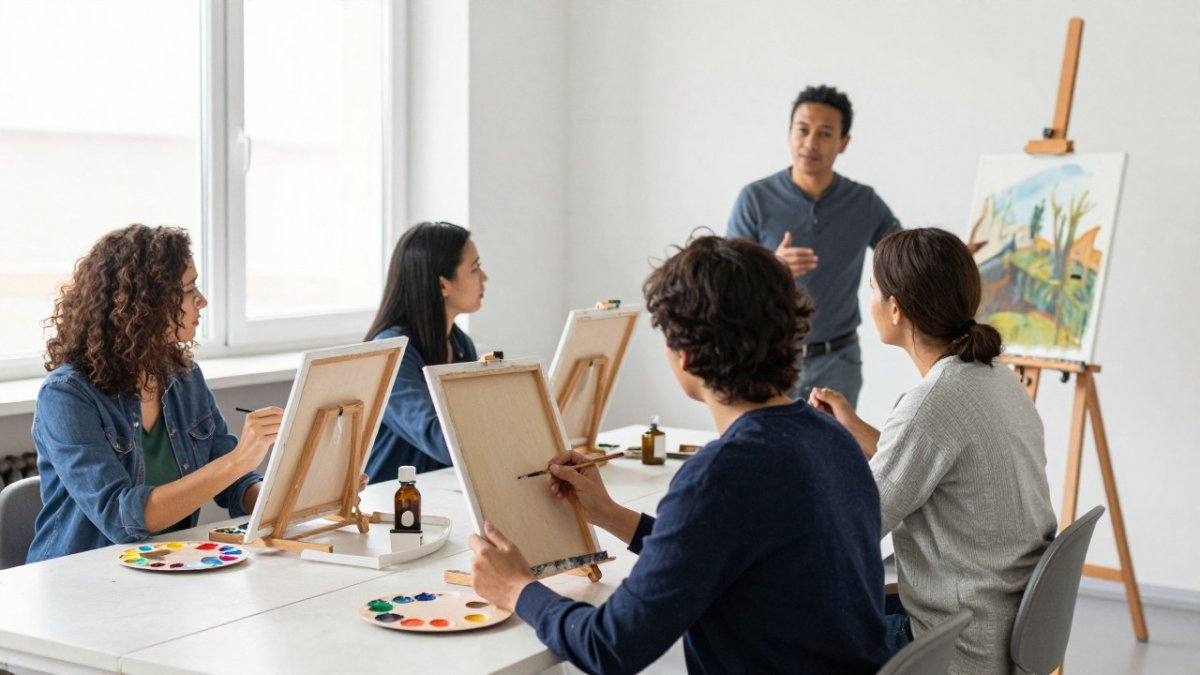
The Three Things Every Session Sells
Every session sells three things at once, and the money comes from all three.
- A social experience. Guests come for the night out, not the art degree.
- Step-by-step instruction. A professional artist walks the room through each stage.
- A finished painting. Guests leave with something they made.
The art is the excuse. The evening is the product. Operators who understand that book more seats than operators who sell "painting lessons."
Studio, Mobile, Venue-Partner, and Franchise Models Compared
Four models dominate paint and sip, and they differ in who owns the space, who carries the fixed costs, and how much control you keep. The table below compares them on the dimensions that decide whether the model fits your capital and lifestyle.
| Dimension | Studio | Mobile | Venue-Partner | Franchise |
|---|---|---|---|---|
| What you own | Lease, tables, easels, sinks, bar area | Van or vehicle, portable easels, supplies | Supplies and booking system; venue owns the room | A license to a proven system, not the brand |
| Typical startup investment | Highest, lease deposit, build-out, furniture, supplies, insurance | Low to moderate, vehicle, portable equipment, supplies, insurance | Lowest, supplies, booking software, insurance | Highest upfront, franchise fee plus build-out and royalties |
| Fixed monthly costs | Rent, utilities, insurance, staff | Vehicle costs, storage, insurance | Minimal; venue takes a cut per event | Royalty and marketing fees on top of operating costs |
| Operational control | Full, you set the schedule, bar, and pricing | High, you choose where and when to host | Shared, venue controls the room and often the bar | Limited, system and brand standards dictate much of the operation |
| Scalability | Limited by one room's calendar; growth means more staff or a second location | Scales by adding vehicles and instructors | Scales by adding venue partners | Scales within the franchise territory |
| Best for | Operators with capital and a local following | Instructors testing the concept | Hosts who want steady bookings fast | Buyers who want a proven playbook |
The trade-offs are real. A studio gives you control over the schedule and the bar, but the lease is a fixed cost that runs whether or not seats sell. A mobile business travels to customers and carries low fixed costs, but you trade a permanent home base for logistics and setup time on every event.
Which Model Fits Your Capital and Lifestyle
Start with the honest question: how much can you lose?
If the answer is "very little," run mobile or venue-partner events first. You learn pricing, teaching, and booking without a lease. If you have savings and want a fixed home base, a studio gives you control over the schedule and the bar.
What most guides miss is that the model is not permanent. Many hosts start mobile, build a customer list, then sign a lease once bookings are steady.
Watch out: the model you choose determines your break-even point before you sell a single ticket. A studio with a fixed monthly lease needs a certain number of classes per month just to cover rent, while a venue-partner host may break even sooner.
Paint and Sip Cost Per Person: Where the Money Goes
Paint and sip cost per person is usually discussed in vague bands, but the model only makes sense when you build one event line by line.
Here is a worked unit-economics structure for a single public class. Build your own figures from your actual quotes, ticket price and attendance.
| Line Item | Per Guest | Per 20-Seat Class | Notes |
|---|---|---|---|
| Canvas, paint, and consumables | $4-$7 | $80-$140 | Buy canvas and acrylic in bulk; cost drops with volume |
| Brushes, easels, aprons (amortized) | $1-$2 | $20-$40 | Reused across dozens of classes; replace worn items |
| Instructor pay | $8-$15 | $160-$300 | Often a flat fee per class or a share of ticket revenue |
| Venue cut or rent | $0-$10 | $0-$200 | Zero if you own the space; a venue partner may take a percentage of ticket sales or a flat room fee |
| Payment processing and booking fees | $1-$2 | $20-$40 | Card processing plus any booking-platform fee |
| Marketing per head | $1-$4 | $20-$80 | Higher when a class is underfilled |
| Total cost per guest | $15-$40 | $300-$800 | Range depends on venue arrangement and instructor pay |
Per 20-Seat Class
Now compare that to revenue. At a $45 ticket, a sold-out 20-seat class brings in $900.
Run the same math at half capacity. Supplies drop because you use less, but instructor pay and venue rent usually do not.
Build the model above before you publish a price, and test it at 50%, 75%, and 100% attendance.
A few cost levers move the margin more than the rest:
- Venue arrangement. A flat room fee is predictable; a percentage of ticket sales scales with revenue and can be cheaper on slow nights but more expensive on sold-out ones.
- Instructor pay structure. A flat per-class fee protects margin on full classes but hurts on empty ones; a revenue share aligns pay with attendance.
- Bulk supplies. Canvas and paint bought in case quantities can lower the per-guest supply line.
- Payment processing. Compare card processing rates and any booking-platform fees; these are a real line item across a year of classes.
Once you have the per-event model, multiply contribution margin by classes per week and weeks per year for a rough annual figure.
How Much Does a Paint and Sip Business Make?
How much a paint and sip business makes depends on seats sold per class, ticket price, and how many classes you run each week. There is no single industry number, and anyone quoting one is guessing.
Run the math yourself. Take your ticket price, multiply by seats sold, then subtract the per-person costs above. That is one class. Multiply by classes per week and weeks per year for a rough annual figure.
Two levers move that number more than anything else:
- Capacity. An empty seat earns nothing but still costs instructor time.
- Repeat bookings. A guest who returns four times is worth four tickets from one acquisition.
Private events, corporate team-building, and birthday parties often pay more per head than public classes. They also fill weeknights that would otherwise sit empty.
Writing a Paint and Sip Business Plan That Survives Year One
A business plan for this model needs a clear set of numbers and a calendar. Most plans fail because they list goals instead of math.
Build these into your plan:
- Break-even point. How many seats per class before you cover costs?
- Realistic capacity. Not the maximum the room holds, the number you can actually fill.
- Seasonality. Which months go quiet, and what fills them?
- Startup costs. Supplies, deposits, insurance, booking software, and a buffer.
Then add a launch checklist with a timeline. Insurance and licensing first, booking system second, test class third, marketing fourth. Skip the order and you will book guests before you can legally host them.
For a full planning walkthrough, our guide on how to plan paint and sip classes turns this section into a working roadmap.
Paint and sip event ideas That Keep the Calendar Full
Bookings dry up when the calendar looks the same every week. Theme nights fix that.
Try these formats:
- Seasonal designs tied to holidays
- Couples nights with two-canvas paintings
- Corporate team-building sessions
- Private parties for birthdays and bachelorette groups
- Beginner-friendly designs for first-timers
The judgment-free environment matters more than the design. Guests who feel safe trying will book again. Guests who feel tested will not.
Mid-week sessions are the hardest to fill. Our guide on how to fill mid-week paint and sip classes covers the themes, schedules, and promos that turn quiet Tuesdays into booked rooms.
Alcohol, Liability, and Licensing for Paint and Sip Operators
Serving alcohol changes your legal exposure, and the rules vary by location and by whether you hold the license or the venue does. Check the current requirements with your local authorities.
The main questions to answer:
- Who holds the liquor license, you or the venue?
- Does your insurance cover alcohol-related incidents?
- Are you checking IDs and limiting service?
- What do your local authorities require for event permits?
A venue partnership often shifts licensing to the venue, which is one reason the model is popular with new hosts. Get the arrangement in writing. Our breakdown of the legal requirements for hosting paint and sip events covers licensing and liability in detail.
Generate Your First Class Design and Test the Model
The fastest way to test any model is one real class with real paying guests. That means you need a design you can teach, not a design you admire.
At PaintPrompt, we built the platform for exactly this step. Describe an idea and you get a class-ready design with a 10-step guide, a color list, and a printable teaching plan.
If you want ready-made designs with teachable steps before you commit to a lease or a van, browse our paint and sip ideas for hosts and home parties and run one test night.
The model only proves itself on a booked calendar with paying guests in seats. PaintPrompt gives you the class-ready designs, 10-step instructions, color lists, and printable teaching guides to fill that calendar without hours of prep.
Frequently Asked Questions
Is a paint and sip business profitable?
It can be, but the margin depends on your model and capacity. A studio with fixed rent needs steady ticket sales to cover overhead, while a mobile or venue-partner setup keeps fixed costs low. Run the numbers on one event: ticket price times seats sold, minus supplies, instructor pay, and venue fees. If that per-event figure stays positive at realistic attendance levels, the model works. Track repeat bookings too, because returning customers cost far less to acquire than first-timers.
Do you need a license to host a paint and sip event?
It depends on whether you serve or allow alcohol. Alcohol licensing and event permit rules vary by location, and some setups allow guests to bring their own under different rules. Check with your local alcohol licensing authority and business licensing office before your first event. If you partner with a bar or restaurant, their license usually covers the alcohol side, but confirm that in writing. You may also need a general business license and, for a studio, a certificate of occupancy.
How much does it cost to start a paint and sip business?
A mobile or venue-partner launch can start with relatively modest spending on supplies, insurance, and a booking system. A leased studio adds rent, deposits, furniture, and build-out, which pushes startup costs much higher. Keep your first launch lean: buy supplies for one class size, book a partner venue, and test demand before signing a lease. PaintPrompt offers a free trial, and you can see current pricing on the PaintPrompt pricing page.
Can you run a paint and sip business without a studio?
Yes. Mobile and venue-partner models are common low-cost launches. You bring supplies and an instructor to a bar, restaurant, brewery, or private home, and the venue handles space and often the alcohol license. You still need reliable transport for canvases and easels, a booking system, and a clear contract with each venue covering setup time, cleanup, and revenue split. Test two or three venue partnerships before committing to a permanent space.
