Affordable Lesson Planning for Art Workshops: 7 Budget Wins
· Editorial Team · 13 min read
Table of Contents
- Why Art Workshop Planning Costs So Much (And Where to Cut)
- Free and Low-Cost Lesson Plan Sources for Art Workshops
- The Art Workshop Lesson Plan Template Every Instructor Needs
- How to Teach a Painting Workshop Without Over-Preparing
- Easy Painting Ideas for Beginners That Keep Supply Costs Down
- Sourcing Donated and Reclaimed Art Supplies in Your Community
- Digital Tools That Cut Art Workshop Planning Costs
- Frequently Asked Questions
Last Updated: September 26, 2026
Why Art Workshop Planning Costs So Much (And Where to Cut)
Affordable lesson planning for art workshops starts with understanding where the money actually goes. Most instructors overspend on three things: premium supplies they don't need, over-preparation time, and last-minute panic purchases. Most hosts burn through budgets simply because they planned backwards.
Where can you cut without hurting quality?
- Skip premium canvas for practice rounds; use canvas paper or board
- Buy primary colors and mix your own secondaries
- Reuse table covers, palettes, and water cups across sessions
- Print guides instead of buying pre-made kits
Free and Low-Cost Lesson Plan Sources for Art Workshops
Free lesson plan databases exist, but they weren't built for paint-and-sip timing. That's the gap most instructors hit. The fix isn't finding more free plans, it's knowing how to compress a classroom plan into a single session without losing the part that makes the painting work. PaintPrompt helps with this by generating class-ready designs.
Free databases and community resources
Blick Lesson Plans offers hundreds of downloadable plans with materials lists, grade-level tags, and step-by-step images. Deep Space Sparkle publishes classroom-tested lessons plus a paid membership tier with video walkthroughs. The Kennedy Center's free lesson library and the National Gallery of Art's teacher resources are also worth bookmarking for technique ideas and art-history tie-ins.
The four-step compression method for classroom plans
Most classroom plans can be cut to a single session with the same four moves:
- Cut the critique and reflection block. Classroom plans often reserve 10-15 minutes at the end for group discussion. In a workshop, guests want a finished painting, not a seminar.
- Collapse multi-day steps into one demo. If a plan spreads underpainting and detail across two days, teach both in a single staged demo, background wash first, details after a short drying break.
- Reduce the palette to five colors or fewer. Classroom plans often list eight to twelve colors. Beginners can't manage that many in 90 minutes, and every extra tube is a cost.
- Pre-mix anything that requires precision. If the plan calls for a specific skin tone or sky gradient, mix it yourself before class and hand out labeled cups. Guests match what they see.
When free templates are not enough
Free plans break down when you need speed. If you're running multiple classes a week, adapting templates can be time-consuming. A tool built specifically for single-session workshops can save hours. PaintPrompt generates a complete class-ready design from a simple description, including a 10-step guide, color list, and printable teaching plan.
A practical logistics checklist for the business side
Most free lesson plans stop at the easel. They don't cover the logistics that actually determine whether a workshop makes money:
- Confirm the venue's sink and drying space before you book, a 12-person class needs roughly 12 linear feet of drying surface.
- Set a minimum enrollment (commonly 6-8 guests for a paint-and-sip) so a half-full class still covers supplies and your time.
- Publish a cancellation window (48 hours is standard) and collect payment up front through a platform like Eventbrite or Square.
- Build a 15-minute buffer before and after class for setup and cleanup that guests never see.
- Keep a one-page run sheet with the timed agenda, supply counts, and emergency contacts taped to your station.
National Art Education Association resources
The Art Workshop Lesson Plan Template Every Instructor Needs
An art workshop lesson plan template is a repeatable document that covers setup, instruction, timing, and cleanup in one page. Build it once, reuse it forever.
The six sections of a repeatable template
- Learning objective (one sentence)
- Materials list (with quantities per guest)
- Timed agenda (warm-up, main painting, finishing touches)
- Step-by-step demo notes (10 steps max)
- Color palette (named colors, not just "blue")
- Cleanup and takeaway instructions
Scaling one template across a full month of classes
Once your template exists, swapping the design is the only variable. One week it's a sunset, next week a mountain lake. The structure stays identical, so your setup routine becomes muscle memory.
| Template Section | Time to Fill | Reusable? |
|---|---|---|
| Learning objective | 2 min | Rewrite each class |
| Materials list | 3 min | Mostly static |
| Timed agenda | 5 min | Adjust by complexity |
| Demo notes | 15-20 min | New each class |
| Color palette | 2 min | New each class |
| Cleanup instructions | 1 min | Static |
How to Teach a Painting Workshop Without Over-Preparing
Over-preparation is the quiet budget killer. Instructors who paint multiple full demo canvases before class may waste supplies and time.
Easy Painting Ideas for Beginners That Keep Supply Costs Down
Easy painting ideas for beginners share one trait: they use fewer than five colors. That's not a limitation, it's a cost strategy.
High-value beginner subjects:
- Sunset over water (three colors: orange, purple, black)
- Single tree silhouette against gradient sky
- Abstract mountain range with palette knife
- Moonlit lake with reflection
- Field of wildflowers using dot technique
Americans for the Arts arts education research
Sourcing Donated and Reclaimed Art Supplies in Your Community
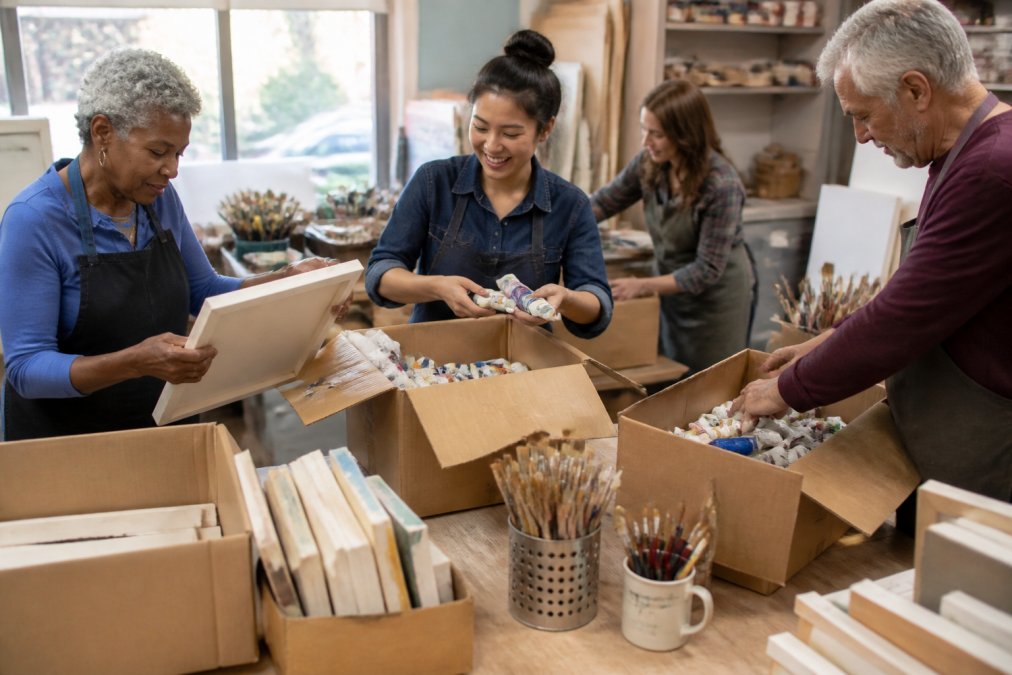
Community donations can cover a meaningful share of your supply needs if you ask in the right places, and if you build the relationships before you need them. Most guides list donation sources and stop there. The part that actually works is the ask, the trade, and the triage.
Where to ask
- Local schools clearing out end-of-year inventory, art teachers often have half-used acrylics, brushes, and paper they can't store over summer.
- Facebook Buy Nothing groups in your area, post a specific wishlist, not a vague request.
- Senior centers retiring or rotating art programs, easels and tabletop supplies are common giveaways.
- Hotels with unused conference supplies, flip chart paper, markers, and sometimes canvas tote bags.
- Art supply stores donating damaged packaging, tubes with cracked caps or dented boxes are still usable paint.
- Local businesses with a community-giving budget, banks, real estate offices, and breweries often sponsor a single class's supplies in exchange for a logo on your event page.
How to make the ask
A generic "do you have any art supplies to donate?" email rarely works. A specific ask does. Include:
- What you need, item types, approximate quantities, and whether opened tubes are acceptable.
- What it's for, one sentence on your workshop and who attends.
- What they get, a receipt for the tax deduction (donated goods are deductible at fair market value for a qualified organization), a thank-you on your event page, or a free seat in a class.
- How pickup works, offer to come to them. Removing the logistics burden is often what tips a yes.
Triage: what to keep, what to pass on
Donated supplies are not free if they cost you class time. Sort every donation into three piles:
- Keep for paid classes: sealed or nearly full tubes, clean brushes, unused canvas or canvas board.
- Keep for practice and warm-ups: partially dried acrylics, stained palettes, short brushes, scrap paper.
- Pass on: oil paints (slow drying, ventilation issues), anything with mold, and dried-out tubes that can't be revived.
Build a standing pipeline, not a one-time haul
Set up a donation bin at your studio and post a public wishlist. Send a short quarterly email to your donor list reminding them what you're low on. Many businesses would rather donate than toss usable materials, but they only remember you when you show up in their inbox.
Digital Tools That Cut Art Workshop Planning Costs
Digital planning tools can reduce instructor prep hours. Planning software can offer significant value.
Three categories worth knowing:
- Lesson plan generators (PaintPrompt): describe your idea, get a full class-ready design with steps and color list
- Course platforms (Ruzuku, starting around $99/month): for scaling into online workshops
- Reference libraries (New Masters Academy, around $35/month): for deepening your own technique
U.S. Small Business Administration business planning resources
Frequently Asked Questions
What should be included in a professional art workshop lesson plan?
A complete art workshop lesson plan template covers six parts: a clear lesson objective tied to one skill, a materials list with exact quantities per student, a step-by-step painting sequence broken into 10 or fewer stages, a color palette reference, timing estimates for each phase, and a finished example image. Include a short warm-up and a buffer block for slower painters. Templates that skip the buffer block tend to run long, which pushes cleanup into overtime and frustrates venue staff.
How can AI tools reduce the cost of art workshop preparation?
AI planning tools generate a class-ready design, a step-by-step guide, a color list, and a printable teaching plan from a single text description. That replaces the hours you would spend searching for reference images, sketching compositions, and writing instructions. PaintPrompt offers a free trial, so you can test whether the output fits your teaching style before committing. The savings come from prep hours, not materials, so track your planning time before and after to see the real difference.
What materials are most cost-effective for group art workshops?
Acrylic paint in bulk 2-liter jugs costs far less per ounce than small tubes, and it works for canvas, paper, and wood surfaces. Buy stretched canvas in multi-packs or use canvas panels, which cost less and take up less storage. Foam brushes and house-brand flat brushes handle most beginner projects. For palettes, use paper plates or plastic trays instead of store-bought options. Buy gesso in gallon containers and prime cheap surfaces yourself rather than paying for pre-primed boards.
How do you structure an affordable art workshop for beginners?
Keep the project to one focal subject and three to five colors. Build the session in blocks: 10 minutes for setup and introductions, 15 minutes for a demo of the first three steps, 60 to 75 minutes of guided painting with the instructor working alongside the group, and 15 minutes for finishing touches and photos. Print one-page guides for each guest so they can follow along without crowding a single screen. Reuse the same structure every session so regulars know the rhythm.
What are the best free resources for art lesson planning?
Blick Lesson Plans offers hundreds of free downloadable plans with materials lists, searchable by age and technique. Deep Space Sparkle provides a free lesson library plus a community forum for troubleshooting classroom management issues. Elaine Luther Art Resources publishes practical guides on setting up an art program on a tight budget. Jenna Rainey's workshop guides cover pricing and logistics. Use these for structure and inspiration, then adapt the projects to your venue, group size, and supply inventory.