Are Free Studio Alternatives Worth It for Art Workshops?
· Editorial Team · 12 min read
Last Updated: November 12, 2026
Quick Summary
Free and low-cost alternatives give you art workshop space without a permanent lease: community centers, libraries, churches, bar or cafe partnerships, shared artist studios, and a corner or garage at home. A mobile kit lets you teach in any room with tables, chairs, and light, set up in under half an hour.
- Call ahead to ask whether a free venue allows wet media, has a sink, and who cleans up.
- Allow about 15-20 square feet per painter at a table, plus a clear aisle.
- Above roughly 12 guests, add a second demo station or a roaming assistant.
- Yellowbird Studio lists hourly studio rental at $50 per hour for workshops and events.
- Break-even seats equal total session cost divided by contribution per seat.
Table of Contents
- Why Hosting Art Workshops Without a Dedicated Studio Works
- Free Alternatives to Expensive Studio Space for Art Workshops
- Shared Artist Studio Space and Co-Working Options
- Art Studio Ideas for Small Spaces at Home
- Mobile Art Workshop Setup: Teaching Anywhere
- What to Look for in a Workshop Venue: Capacity, Safety, and Cleanup
- Cost Comparison: What Each Option Really Costs
- Finding and Booking Short-Term Workshop Space
- Frequently Asked Questions
Why Hosting Art Workshops Without a Dedicated Studio Works
Renting a permanent studio sinks a workshop budget before a single seat sells.
Stop thinking of "studio" as a place and start thinking of art workshop space as a resource you rent by the hour, borrow by the evening, or build in a corner you already pay for.
Below: the real alternatives, what each costs, and how to set up a mobile kit so you can teach anywhere.
Free Alternatives to Expensive Studio Space for Art Workshops
Free options exist, and they're not all grim fluorescent rooms. The trick is knowing which free space suits which group, because a library meeting room and a bar back room behave very differently once paint starts flying.
Community Centers, Libraries, and Churches
Community centers, libraries, and churches are the most reliable free or near-free venues for a paint and sip session. The trade-off is scheduling: you take what's open, often weekday evenings.
Call ahead and ask three questions: Do they allow wet media? Is there a sink? Who cleans up? A church hall with a utility sink and wipeable floors beats a carpeted library room every time.
Bars, Cafes, and Retail Partners
Partnering with a bar or cafe can turn a slow Tuesday into a packed event for both of you. The venue gets foot traffic, you get a room, and you often split revenue or pay a modest minimum spend.
The catch is legal and logistical. Our guide to the legal requirements for hosting paint and sip events covers those questions.
Shared Artist Studio Space and Co-Working Options
Shared artist studio space splits rent across several makers, dropping your per-hour cost while giving you a real sink, proper ventilation, and storage you don't pack up each night.
The catch is shared rules. Cleanup schedules, equipment use, and guest policies need to be written down or you'll have friction fast. A simple art studio operations manual keeps a shared space running without daily negotiation.
Art Studio Ideas for Small Spaces at Home
A home studio doesn't need a spare bedroom. It needs a surface, storage, and a way to disappear when dinner is ready.
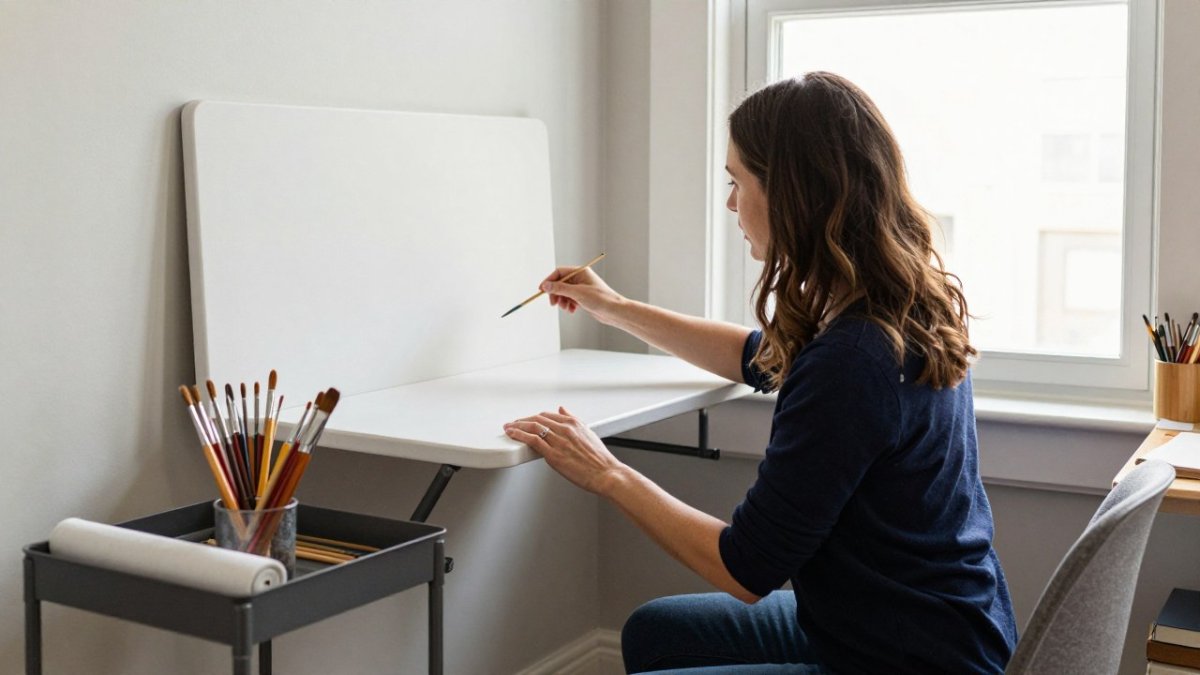
Corners, Closets, and Fold-Down Tables
The best small-space art studio ideas start with a single wall. A corner with a fold-down table gives you a work surface that vanishes in seconds. A closet conversion holds supplies behind a door.
Here's a checklist for turning a corner into a working art workshop space:
- A sturdy fold-down or wall-mounted table at standing height
- A rolling cart for brushes, paints, and canvases
- Clip-on lighting aimed at the work surface
- A washable floor mat or drop cloth
- A nearby sink or a water bucket for cleanup
- Vertical storage so supplies leave the table clear
Watch out: ventilation is the item people skip. Acrylics are forgiving, but solvent-based mediums and spray fixatives need airflow, so keep a window open or work outdoors.
Mobile Art Workshop Setup: Teaching Anywhere
A mobile art workshop setup is a portable kit that lets you teach in any room with tables, chairs, and light.
Pack for one guest at a time, then multiply. Each guest needs a canvas, brush set, water cup, paper towel, and palette, stacked into a large tray per person so setup and teardown are grab-and-go.
The teaching plan is where most mobile hosts get stuck. Standing in a strange room with no lesson ready is a recipe for a flat class.
What to Look for in a Workshop Venue: Capacity, Safety, and Cleanup
The right venue comes down to three things: capacity, safety, and cleanup. Get those right and the event runs itself; get them wrong and you'll spend the night apologizing. But the deeper question is fit: a room that works for a 10-person watercolor class can fail badly for a 20-person acrylic pour night.
Matching the Venue to the Workshop Type
Different media impose different demands on a room. Use this as a starting filter when you tour a space.
- Acrylic and watercolor painting: Needs a sink or water source, wipeable floors, and tables wide enough to lay a canvas flat. Ventilation matters less than cleanup. A community center craft room or a bar back room with a utility sink works well for 10-16 guests.
- Oil painting and solvent-based mediums: Requires strong ventilation, solvent-safe waste disposal, and usually a room where food service is not happening. Many libraries and churches prohibit solvents outright. A shared artist studio or a garage with a window and fan is a better fit.
- Printmaking (linocut, monotype): Needs sturdy tables that can take pressure, a way to secure a press or hand-printing station, and floor space for drying racks. Shared studios with equipment access beat borrowed rooms.
- Crafts, collage, and mixed media: The most flexible category. A library meeting room, cafe back room, or home corner handles 8-12 guests if you bring drop cloths and a rolling cart.
- Pottery and clay: Rarely viable outside a dedicated studio because of water, clay dust, and kiln access. Treat this as a studio-share or residency scenario, not a borrowed-room one.
Capacity: Plan for Elbow Room, Not Chairs
A room that seats twenty for a meeting often fits twelve painters comfortably. Guests need space to set a canvas flat, step back, and move between tables without brushing wet work.
Group size also changes your teaching model. If you're weighing a tight, unconventional venue, our guide on how to manage large groups in a small painting studio gives you the layout and flow tactics that keep a crowded room calm.
Safety and Cleanup: The Questions That Decide the Booking
On safety, confirm exits, flooring that survives a spill, and ventilation for your mediums. Ask whether the venue has a fire extinguisher rated for the room and whether sprinkler or alarm rules affect aerosols or heat tools.
Watch out: some library rooms prohibit solvents and require drop cloths, so confirm before you book. The same applies to bars and cafes that serve food, a venue may allow painting but not solvent-based mediums in the same room.
Accessibility and Participant Comfort
Ask about step-free entry, restroom access, and lighting before you commit. Natural light is pleasant but unreliable for evening classes, so confirm overhead lighting is bright enough to judge color. For older groups or anyone with mobility needs, a ground-floor room with nearby parking removes friction that shows up as late arrivals and cancellations.
Cost Comparison: What Each Option Really Costs
Costs vary by market and venue, so pricing depends on the venue, dates, and what is included. The honest comparison is not just rent. It's rent plus setup time plus cleanup plus the risk of a bad fit.
| Option | Typical Cost Model | Setup Effort | Best For |
|---|---|---|---|
| Community center or library | Free to small donation | Low to medium | Tight budgets, weekday groups |
| Bar or cafe partnership | Minimum spend or revenue split | Low | Social paint and sip nights |
| Shared artist studio | Monthly access fee, split | Low | Hosts teaching weekly |
| Home corner or garage | One-time setup cost | Medium | Small private groups |
| Hourly venue rental | Per-hour rate | Low | Occasional or premium events |
| Mobile kit in any room | Kit cost only | High per event | Hosts who travel |
One real-world data point: Yellowbird Studio lists hourly studio rental at $50 per hour for workshops and events, according to its adult art parties listing.
Comparing Hourly, Daily, and Monthly on the Same Basis
Rent quotes arrive in different units, so convert everything to a cost per workshop session. For an hourly venue, multiply the rate by the hours you actually need, including setup and cleanup. A $50-per-hour room booked for a three-hour class with one hour of setup and one hour of cleanup is a five-hour booking, or $250 per session. For a monthly shared studio, divide the fee by the sessions you realistically run: a $600 monthly bay used for four sessions is $150 per session; used for eight, it's $75.
A Simple Break-Even Framework
Before you commit, run the numbers against enrollment. Break-even seats equal total session cost divided by contribution per seat, where contribution is ticket price minus per-guest materials.
Use that framework to set a rent ceiling. For more detail, our breakdown of how to price your paint and sip workshop for profit walks through per-seat costs, materials, and a profitable ticket price.
Costs Hosts Forget to Count
Beyond rent, budget for drop cloths and cleanup supplies, travel time to and from the venue, insurance if the venue requires it, and the deposit or minimum spend a bar partnership may carry. A revenue split with a cafe can look cheaper than an hourly room until a slow night leaves you paying a minimum with few guests.
Finding and Booking Short-Term Workshop Space
Short-term rental is the flexible middle ground between a permanent lease and a borrowed room.
Start with venue listing platforms and local arts networks.
For community-rooted options, nonprofit arts organizations are worth a call. The Cedars Union, a nonprofit arts incubator, provides studio space and supports an arts community, according to its organization site.
Once you've picked a venue, the booking itself has a sequence: confirm dates, get the cleanup and access rules in writing, pay the deposit, and send guests the address and arrival time. Our painting event planning guide for beginners lays out that full timeline step by step.
The hosts who keep their margins healthy aren't the ones hunting for the cheapest room.
Frequently Asked Questions
Where can I host an art workshop without renting a studio?
Community centers, libraries, churches, bars, cafes, and retail stores may rent rooms or host events, and pricing depends on the venue and dates. Shared artist studio space and co-working venues also rent by the hour. For small groups, a home corner, garage, or fold-down table setup works. Match the venue to your group size and whether you need sink access and ventilation, then confirm cleanup rules and insurance requirements before booking.
What is the difference between a studio and a workshop?
A studio is a permanent space where an artist works and stores supplies, while a workshop is a scheduled class or session where people gather to paint or make art. You can run a workshop in a studio, but you do not need a studio to run a workshop. Many hosts use borrowed or rented rooms, mobile art workshop setups, or shared artist studio space for the class itself and keep supplies stored at home.
Can I run art workshops from home?
Yes, if you have enough room and can manage cleanup and ventilation. Art studio ideas for small spaces include using a corner with a fold-down table, converting a closet into a supply station, or setting up in a garage or laundry room with a drop cloth. Keep group sizes small, protect floors, and check local rules on running a business from home. For larger groups, a borrowed community room is usually more practical.
How can I find free or low-cost space for art classes?
Start with community centers, libraries, churches, and schools that rent rooms cheaply or free for local instructors. Ask bars and cafes about hosting a class on a slow night in exchange for bringing in customers. Check shared artist studio space and co-working venues for hourly rates, and look at venue listing sites for short-term rentals.
What should I look for when choosing a space for an art workshop?
Check capacity for your group size, work surface area, lighting, ventilation, and sink access for cleanup. Confirm whether tables, chairs, and easels are included, and ask about additional fees, insurance requirements, and cleanup rules. For paint classes, ventilation and floor protection matter most. Visit the space in person if you can, and test the setup with your supplies before the first paid class so you are not solving problems in front of guests.
