How to Manage Large Groups in a Small Painting Studio
· Editorial Team · 12 min read

Last Updated: November 5, 2026
Quick Summary
Manage large groups in a small painting studio by calculating your real guest limit before buying furniture: measure clear floor space, subtract aisles of about 36 inches, leave one gap seat per row, and cut the total by 10% as a buffer. A room that seats 20 at a dinner party often holds 12 to 14 painters comfortably.
- Trace three clear paths with floor tape: entry to seats, seats to supplies, and seats to the sink.
- Split the room into four overlapping zones: wet, dry, demo, and cleanup.
- Pre-stage one supply tray per two seats before doors open to save 20 minutes.
- Pause the room every 15 minutes so everyone moves to the same step together.
- Release rows one at a time for breaks and cleanup, and keep bags out of aisles.
Table of Contents
- Start With Capacity, Not Furniture
- Designing a Small Art Studio Layout for Classes
- Your Painting Class Setup Checklist
- Building a Group Painting Workshop Lesson Plan
- The Painting Class Supply List for Groups
- Keeping a Full Room on Schedule and Safe
- Generate Your Next Group Class Design
- Frequently Asked Questions
Start With Capacity, Not Furniture
The biggest mistake we see studio owners make is buying tables and easels before they know how many people the room can actually hold. Establishing these precise clearance requirements serves as the foundation for any attempt to organize studio space, a principle that remains equally critical when you transition to more complex equipment layouts.
Calculate Your Real Guest Limit
Measure the clear floor space, then subtract every aisle. A safe aisle needs about 36 inches of clear width so guests can move without bumping wet canvases. From there:
- Count usable table seats, not total seats
- Leave one gap seat per row for supply access
- Cut the total by 10% as a buffer for bags and coats
A room that seats 20 at a dinner party often holds 12 to 14 painters comfortably.
Map Safe Aisles Before You Move Anything
Walk the room and trace your routes with tape on the floor. You need three clear paths: entry to seats, seats to supplies, and seats to the sink. OSHA guidance on exit routes and walking surfaces reminds employers that clear travel paths matter for safety, and a crowded studio is no different.
The article's capacity math comes down to a few concrete numbers you can apply before buying anything.
| Item | Value | Note |
|---|---|---|
| Safe aisle clear width | About 36 inches | So guests can move without bumping wet canvases |
| Gap seats per row | One | Left open for supply access |
| Buffer on total seats | 10% | For bags and coats |
| Dinner-party room of 20 seats | 12 to 14 painters | Comfortable painting capacity |
| Clear paths needed | Three | Entry to seats, seats to supplies, seats to sink |
Designing a Small Art Studio Layout for Classes
A small art studio layout for classes works when every zone pulls double duty. The goal is a workspace where setup, painting, and cleanup happen in the same footprint without collisions.
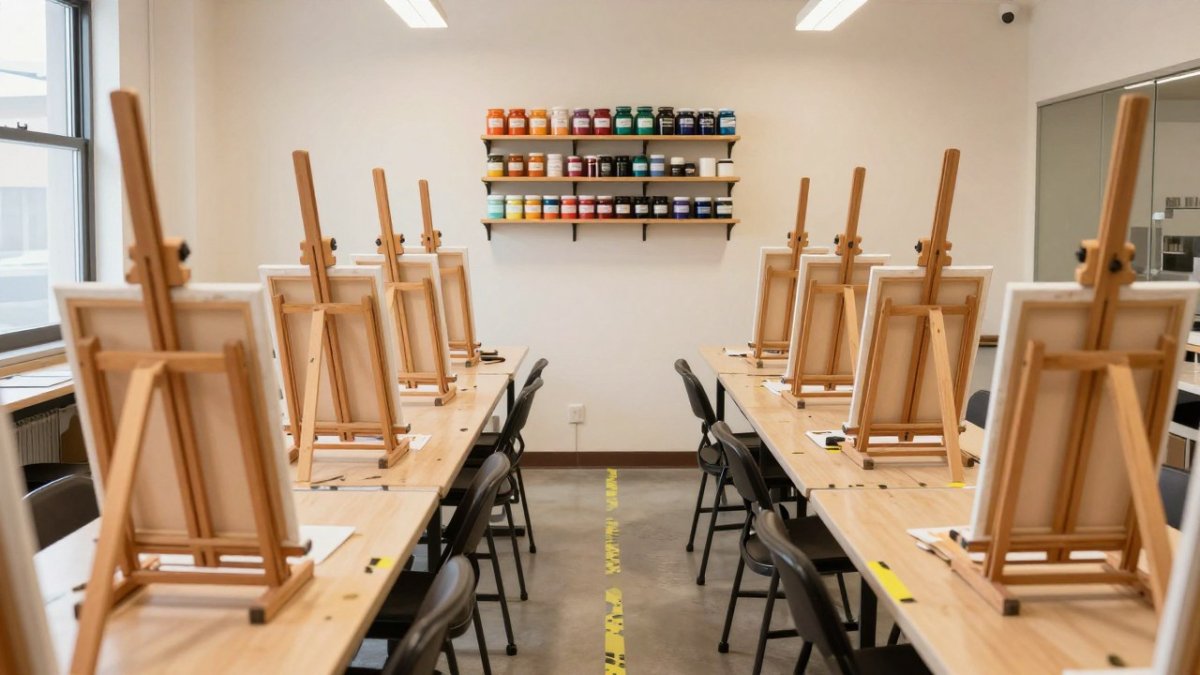
Zones That Do Double Duty
Split the room into four zones, then let them overlap:
- Wet zone: paints and water cups, closest to the sink
- Dry zone: canvases and aprons, near the entry
- Demo zone: one easel at the front with the best sightlines
The dry zone becomes the checkout table at the end of the night. The demo zone doubles as a photo spot. Flexible zoning means you never waste floor space on a single-purpose area.
Vertical Storage That Frees Floor Space
Wall-mounted storage is your best friend in a tight room. Shelves above shoulder height hold backup supplies. Hanging baskets corral brushes and rags. Rolling drawers slide under tables and disappear when class starts. The floor stays open for people, which is the whole point.
Your Painting Class Setup Checklist
A painting class setup checklist keeps you from scrambling at the last minute. Run it once before every session and the room runs itself.
Before guests arrive (30 minutes):
- Confirm seat count against your capacity limit
- Tape aisles and check every route
- Set one water cup, brush set, and canvas per seat
During class:
- Keep backup supplies within arm's reach of the demo easel
- Reserve one staff member for supply refills
After class:
- Wipe tables while paint is still wet
- Restock shelves before you leave
If you want a repeatable system that locks these steps in as the studio grows, our guide to building an art studio operations manual walks through the whole process. For a vetted list of instructor tools that make this checklist faster, see our tools for art workshop instructors.
Building a Group Painting Workshop Lesson Plan
A group painting workshop lesson plan is the difference between a calm session and chaos. The plan has to account for slow painters, fast painters, and the friend who arrives late.
Start with a design that breaks into simple shapes, then build in checkpoints. For deeper teaching techniques that keep a crowded room on track, our guide on how to teach painting workshops effectively covers the full approach.
Keeping the Demo Visible in a Crowded Room
Visibility is the sneaky problem in a packed studio. Back rows cannot see a tabletop demo, and that is where paintings fall apart.
- Raise the demo easel so the canvas sits above seated head height
- Use a large test canvas so strokes read from the back row
- Repeat each step twice: once slow, once at class pace
One insider tip: assign a helper in the last row to relay questions forward. It saves you from shouting across the room all night.
The Painting Class Supply List for Groups
The painting class supply list for groups is shorter than most instructors think, but the quantities and the distribution system matter more than the list itself.
Quantities That Actually Hold Up
Build your list around per-seat counts plus a buffer, then round up to full containers so you are not measuring partials at the last minute. A common pattern for a 12- to 14-seat session:
- Acrylic paints in primary colors plus white and black, one 2-oz squeeze bottle of each per four seats, with white and black doubled because they run out first
- One medium flat brush and one large flat brush per guest, plus two spare brushes per table
- Pre-primed canvases, one per seat plus two spares for the guest who arrives with a friend or wants a restart
Watch out: buying paint in large tubs to save money backfires in a group setting, because every refill becomes a pouring station and a spill risk. Squeeze bottles keep the paint at the seat and out of the aisle.
Pre-Staged Trays Beat Seat-by-Seat Handouts
Handing out supplies seat by seat eats 20 minutes and clogs the aisles while guests arrive. Instead, pre-stage one supply tray per two seats before the doors open, and set the trays on the tables so guests find their materials already waiting.
Group supply distribution works best when it mirrors the room layout. If your tables run in rows, stage trays in row order on a back shelf and have one staff member walk the row with a cart.
Cleanup Runs in Reverse
Cleanup works the same way in reverse: one bin per table, collected row by row, with water cups emptied into a bucket rather than the sink so you do not clog the drain with paint. Keep a labeled lost-and-found box by the door for brushes and aprons left behind. Group cleanup systems like these help cut the end-of-night scramble and protect your sink, your floors, and your brushes.
Label Everything That Moves
In a crowded room, supplies migrate. Label trays, bins, water pitchers, and brush cups with table numbers or color tape so they return to the right zone at the end of the night. A common pattern is color-coding by table: red tape on table 1's tray, blue on table 2's, and so on. When a guest moves a tray, the tape tells you where it belongs, and restocking becomes a matching game instead of a hunt.
Keeping a Full Room on Schedule and Safe
Schedule and safety are the same conversation in a small painting studio. A packed room with a blocked exit, a spilled water cup, or a guest who cannot reach the sink is a real hazard, not a minor annoyance. The fix is to design movement into the session instead of reacting to it.
Stagger Arrival, Breaks, and Cleanup by Row
Set a hard timeline and post it where guests can see it. Announce each checkpoint out loud so the room moves together.
For arrival, open the doors 15 minutes early and check guests in at a table near the entry rather than at their seats.
Watch out: never let bags and coats pile in the aisles.
Ventilation and Spill Response
Acrylics are water-based, but a crowded room still needs air movement. Run a fan or open a window before the session starts, and keep solvent-based mediums out of group classes entirely. Keep a spill kit within reach of every table: paper towels, a small bucket, and a mop or absorbent pads. Small water cups refilled often keep a spill small, and a bucket for emptying cups keeps paint out of the sink drain.
Accessibility and Safe Routes
Walk the room as if you were a guest on crutches. Keep at least one accessible seat at the end of a row with a clear approach, and reserve a wider aisle near the demo easel for guests who need to stand or reposition. OSHA guidance on exit routes and walking surfaces reminds employers that clear travel paths matter for safety, and a crowded studio is no different.
A Posted Safety Briefing
Post a short safety briefing by the door and read it aloud in the first two minutes: where the exits are, where the spill kit lives, how to carry a wet canvas, and where to put bags. Guests follow rules they can see and hear. Our time-saving tips for painting instructors go deeper on keeping a packed class moving without the chaos.
Generate Your Next Group Class Design
Planning a group session in a small room takes time you may not have. That is where PaintPrompt comes in. Describe your idea and you get a complete, class-ready design with a 10-step guide, a color list, and a printable teaching plan, all built by real paint and sip hosts.
You can plan a full month of classes in minutes, with beginner-friendly compositions. If you want ready-made templates to speed up planning, browse our painting class design templates.
Frequently Asked Questions
How many people can fit comfortably in a small painting studio?
Work backward from aisle space rather than room area. Each guest needs roughly 2 feet of table width plus a clear path behind the seat. In a 400-square-foot room, that usually lands around 12 to 16 painters once you subtract the demo area and supply station. Test your number by setting up chairs and walking the room yourself. If you cannot pass behind every seat without turning sideways, you have one or two guests too many.
How should painting supplies be organized for a group workshop?
Build a painting class supply list for groups around pre-portioned kits, not shared piles. Each seat gets one cup of water, a paper towel, a palette with the exact colors for that design, and two brushes. Keep backup brushes and extra paint at a central station so you refill mid-session without hunting. Label bins by color and return everything to the same spot after each class, which cuts setup time for the next group.
How can an instructor help everyone see a painting demonstration?
Raise the demo surface so it sits above seated eye level, and paint on a canvas that faces the room rather than you. For groups over 12, split the demo into two short rounds at opposite corners so no one watches from the back. A phone on a tripod pointed at your canvas, mirrored to a tablet at the front, solves sightlines in tight rooms. Repeat each step twice and describe it out loud for guests whose view is blocked.
How do you keep a group painting class on schedule?
Set time markers before guests arrive: block-in done by minute 20, background by minute 45, details by minute 70. Announce each marker out loud so slow painters know where to catch up. Choose designs with a simple shape guide, since a clear block-in step keeps a group moving together. Build 10 minutes of buffer at the end for cleanup and photos.
Managing a big group in a tight room comes down to capacity math, clear aisles, and a plan everyone can see. PaintPrompt gives you the class design, step-by-step instructions, and printable teaching guide so setup takes minutes, not hours. Try the free trial and see how fast a full month of classes comes together. Get started with PaintPrompt and walk into your next packed session with a design that works.
