Creative Team Building Art Activities: 7 Ideas That Work
· Editorial Team · 16 min read
Table of Contents
- Why Art Activities Build Stronger Teams Than Another Trust Fall
- Quick Team Building Art Exercises for Busy Teams
- Collaborative Art Projects for Adults: Murals, Pottery, and Group Canvas Challenges
- How to Plan a Team Building Painting Class That Runs Itself
- DIY vs. Professional Facilitation: What Your Budget Actually Buys
- Making Art Team Building Accessible to Every Employee
- Virtual and Hybrid Art Team Building That Doesn't Feel Awkward
- The Debrief: Turning Paintings Into Real Team Insights
- Frequently Asked Questions
Last Updated: September 29, 2026
Why Art Activities Build Stronger Teams Than Another Trust Fall
Creative team building art activities work because they give people a shared problem to solve with their hands.
Quick Team Building Art Exercises for Busy Teams
Quick team building art exercises are short, low-prep activities that fit into a lunch break or a 20-minute meeting slot. The goal isn't a masterpiece. It's a shared moment of creative thinking that resets how people see each other.
Five formats that consistently land:
- Exquisite corpse drawing. One person draws a head, folds the paper, passes it on. The next adds a torso, and so on. Reveal at the end.
- One-line portraits. Each person draws a colleague's face without lifting the pen. Laughter guaranteed.
- Color swap sketch. Two people draw the same object using only the colors the other person chose.
- Sticky-note mural. Everyone adds one doodle and one word that describes the team. Assemble on a wall.
- Blind contour drawing. Draw your own hand without looking at the paper. Compare results.
Collaborative Art Projects for Adults: Murals, Pottery, and Group Canvas Challenges
Collaborative art projects for adults turn individual contributions into something none of you could make alone, and the finished piece becomes a physical reminder of what the team built. Whether a session lands or stalls comes down to setup mechanics, not the art.
Collaborative Mural Painting
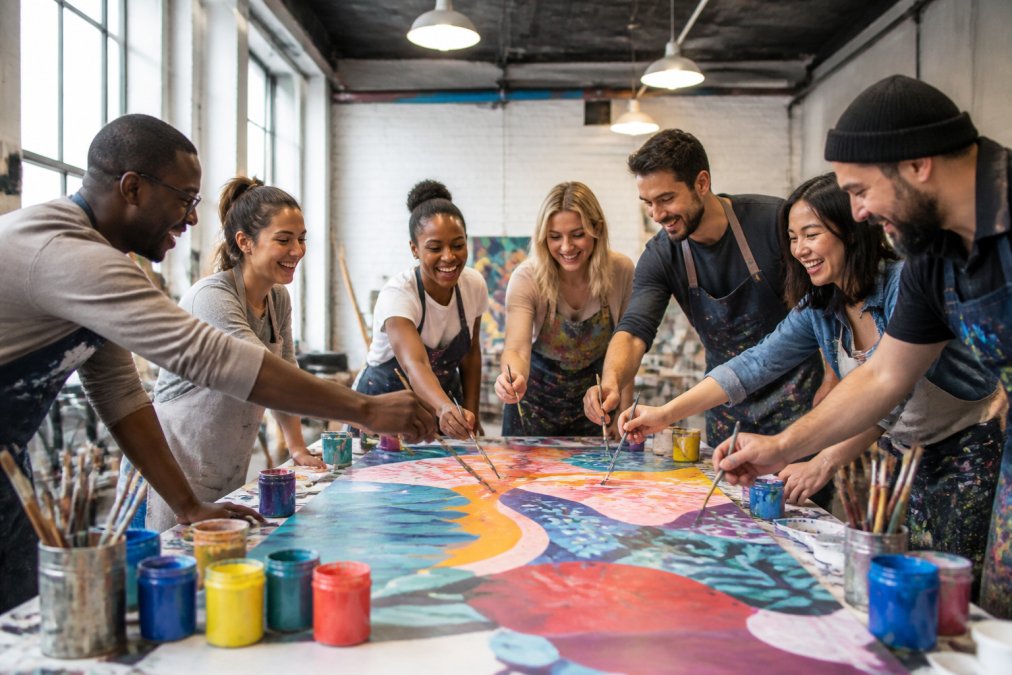
A collaborative mural splits one large image into sections, and each person or small group paints their piece. The magic is in the reveal: people who spent an hour on their own square suddenly see how it fits, a visual lesson in how individual work connects to the whole.
Pottery and Clay Hand-Building
Clay is tactile in a way paint isn't. Hand-building projects like pinch pots, coil bowls, or small slab sculptures let people get messy without pressure.
Canvas Challenges and Neon Painting Nights
Canvas challenges give everyone the same prompt and a time limit; neon or glow-in-the-dark painting adds a twist that works well for evening events.
| Format | Setup Time | Best Group Size | Materials Needed |
|---|---|---|---|
| Quick exercises | 5 min | 4-20 | Paper, pens |
| Collaborative mural | 30-60 min | 10-50 | Large canvas, acrylics, painter's tape |
| Pottery hand-building | 60+ min | 8-20 | Air-dry clay or kiln access |
| Canvas challenge | 15 min | 10-100 | Canvases, acrylics |
| Neon painting | 20 min | 10-40 | Blacklight, neon paints, dark base coat |
Adapting These Projects for Mixed Ability Levels
Every format above can run at two or three difficulty tiers in the same room, which is the difference between a team-building session and a talent test. For a mural, offer a "detail" square and a "color block" square. For clay, pair a simple pinch-pot model with an open-ended prompt. For canvas challenges, keep core shapes large and forgiving, and let advanced painters add texture as an optional final step.
How to Plan a Team Building Painting Class That Runs Itself
The best team building painting class is one where the instructor barely intervenes, which happens when the design is beginner-friendly and the steps are pre-planned.
Here's the sequence that works:
- Pick a design with clear shapes. Landscapes, sunsets, and simple abstracts work better than portraits.
- Pre-mix your colors. Fewer decisions mean fewer stalls.
- Break the painting into 10 steps or fewer. Each step should take 5 to 8 minutes.
- Print a guide for every guest. A visual reference keeps people on track without hand-holding.
- Build in a buffer. Some people paint fast. Give them a detail step to add.
DIY vs. Professional Facilitation: What Your Budget Actually Buys
DIY art sessions cost less upfront but demand more from the organizer. Professional facilitation costs more but removes the planning burden and usually produces better results for larger groups.
What you're actually paying for with a facilitator:
- Materials sourcing. They bring the canvases, paints, brushes, and cleanup supplies.
- Instruction and pacing. They keep the group moving and handle stragglers.
- Contingency plans. When someone spills or a design flops, they adapt.
- Group management. They read the room and adjust the energy.
| Factor | DIY | Professional Facilitation |
|---|---|---|
| Upfront cost | Low | Higher |
| Prep time | High | Minimal |
| Best group size | Under 15 | 15-100+ |
| Materials | You source | Included |
| Instruction quality | Varies | Consistent |
Making Art Team Building Accessible to Every Employee
Accessibility is the part most art team building guides skip. If your activity excludes people with mobility issues, sensory sensitivities, or limited art experience, it isn't really team building. It's team building for some of the team.
Practical steps:
- Offer seated and standing options. Not everyone can stand at an easel for an hour.
- Provide adaptive tools. Chunky grips, larger brushes, and easel alternatives help people with limited dexterity.
- Skip the skill judgment. Frame every activity as process, not product. No critiques, no comparisons.
- Watch sensory load. Strong smells, loud music, and bright flashing lights can overwhelm some participants.
- Give a no-pressure opt-out. Let people participate as observers or helpers without penalty.
Virtual and Hybrid Art Team Building That Doesn't Feel Awkward
Virtual art sessions fail when they try to replicate an in-person class. They work when they lean into what the format does well: low pressure, easy participation, and no travel. The gap in most guides is logistics, how kits reach people, which platform features keep a session synced, and how to keep remote participants from becoming spectators in a hybrid room.
Shipping Supply Kits Without Breaking the Budget
The biggest predictor of a virtual session's success is whether everyone has the same materials in hand. Improvised supply lists, "bring whatever paper you have", produce mismatched results and quiet disengagement.
Platform Setup That Keeps Everyone Synced
A shared design with clear steps is the backbone of a virtual session. Put the step guide on screen as a shared slide deck or pinned image, and angle a second camera or phone down at the facilitator's canvas so people can watch technique in real time.
Making Hybrid Work for the Remote Half
Hybrid is the hardest format, and the failure mode is predictable: the in-room group gets the energy and the remote group gets a screen. The fix is structural.
The Debrief: Turning Paintings Into Real Team Insights
A simple debrief structure, 10 to 15 minutes:
- What surprised you about your own process?
- Where did you get stuck, and what helped?
- What did you notice about how the group worked together?
- What's one thing from today you want to bring back to how we work?
Teams that debrief well repeat these activities; teams that skip it treat art as a one-off. The difference is a 15-minute conversation.
Frequently Asked Questions
What are some creative ideas for group artwork at work?
Collaborative murals, group canvas challenges, and pottery hand-building are the most popular options. A mural works well because everyone contributes to one finished piece, which can hang in the office afterward. Canvas challenges split the team into small groups racing to complete the same painting. For tactile groups, clay hand-building lets people shape individual pieces that get displayed together. Quick exercises like drawing games or icebreaker sketches work when you only have 15 to 20 minutes.
How do art activities improve team communication?
Art activities force people to explain ideas without relying on jargon. When a team works on collaborative art projects for adults, they have to describe what they want, negotiate space, and adjust to what someone else is doing. That mirrors how cross-functional teams solve problems. A facilitated session can also surface who naturally leads, who supports, and who needs clearer direction, which is useful information for managers.
How many people can join a team building painting class?
Most studio-based painting classes handle 10 to 30 people comfortably, depending on table space. Larger groups of 50 or more usually need a venue with multiple stations or a split into rotating sessions. If you are planning a team building painting class for a big department, book the venue first and confirm the guest-to-instructor ratio. A ratio of one instructor per 15 to 20 painters keeps the session moving and ensures beginners get help when they fall behind.
Do we need art experience to run these activities?
No. Quick team building art exercises like drawing games, collaborative coloring, or silhouette challenges need zero instruction. For a full painting class, tools like PaintPrompt generate a class-ready design with 10-step instructions and a printable teaching guide, so a manager with no art background can run the session. If you want a professional facilitator, you can find instructors who handle setup and teaching.
What is the best way to debrief after an art team building session?
Ask three questions: what surprised you about how your group worked together, where did communication break down, and what would you do differently next time. Keep it to 10 minutes and let people talk while they are still looking at the artwork. The painting becomes a shared reference point. Teams that skip the debrief often remember the activity as fun but cannot connect it to how they work day to day.